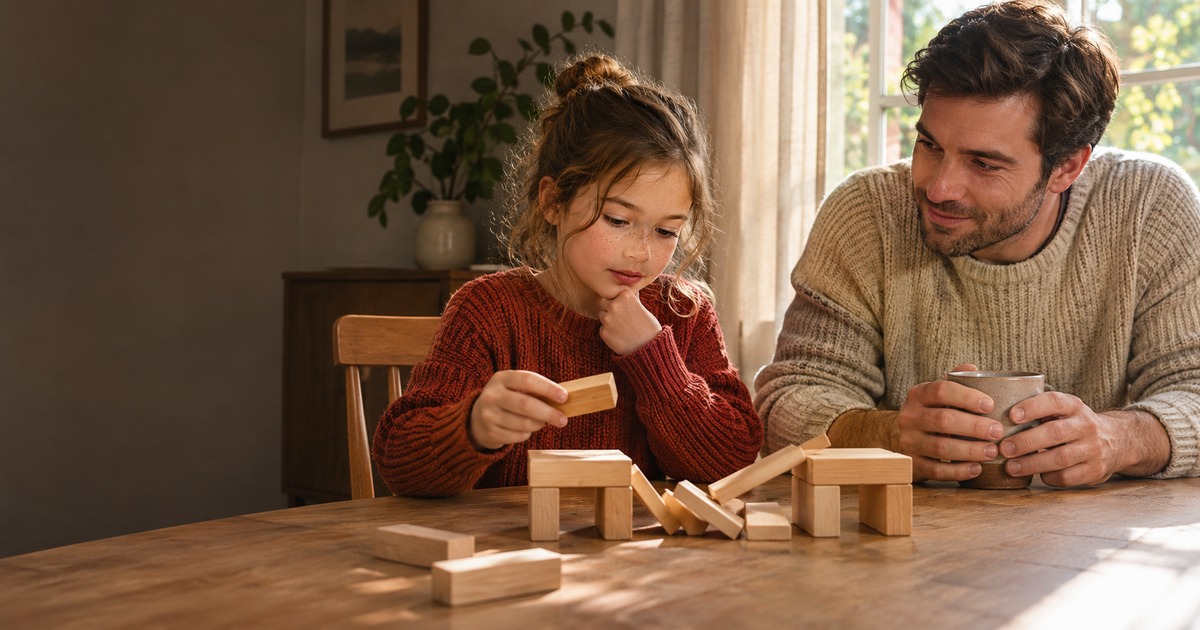
Your child builds a bridge from blocks. It falls, and your hand is already reaching for the wider block that would make a better base. Before you put it in place, see what your child does next. They might try a wider block, build something shorter, or ask you to hold one side. Each option gives them a decision they can make again another day.
Learning how to let kids fail starts with choosing a situation they can recover from. Stay close, let them take a turn at solving it, and offer help in small steps. When safety, access to care, or a serious consequence is at stake, take responsibility for the immediate problem. Use the decision table and worksheet to match your support to the moment.
Decide how much help the situation needs
Ask what would happen if your child tried one more time. A bridge that falls on a clear table is easy to rebuild. A deadline with a serious penalty requires an adult to help work out a plan. Consider whether the mistake is repairable, who else would be affected, and whether your child has the time and tools to try.
| Situation | Adult response | Decision the child can keep |
|---|---|---|
| The mistake is safe and easy to undo, and your child is still experimenting. | Stay nearby and give them time to make another move. | What to change about a wobbly block bridge. |
| Your child wants help or keeps getting stuck at the same step. | Offer a cue, a choice, or help with one part. Give them the next turn. | Where to put a reminder for a library book. |
| There is an immediate hazard, bullying, or a risk of losing access to something essential. | Step in promptly. Involve the responsible adult or school when needed. | Once safe, which part of the follow-up they want to help with. |
Check your child's state as well as the stakes. A child who is engaged may want another turn. One who is overwhelmed may need a break, a familiar tool, or help getting started. Adjust for what they can do that day and keep any accommodations they use. A noisy room, hard-to-read instructions, or a task with too many steps may be the barrier.
Consider your own time limit, too. If you need to leave in five minutes, say which part you can help with now and find a quieter time to practice. A weekend afternoon may give a child the space to repack a bag that a school morning cannot.
Offer one piece of help, then return the next turn
The Center on the Developing Child at Harvard University describes how adults can support a challenging task and gradually reduce that support as children are ready to manage more of it. The American Academy of Pediatrics suggests using small cues during play so children can try a solution themselves. Harvard's guide to practicing executive function skills and the AAP's guide to problem-solving through play describe these approaches.
- Wait for one move. If your child is still looking through the pieces, stay present while they pick one. Give them time to use what they are noticing.
- Ask what kind of help they want. “Would you like a hint, an extra pair of hands, or a little more time?” If choosing feels like too much, offer one concrete option.
- Point to something they can use. “I saw the bridge tilt when the taller block went underneath.” Leave the choice of what to move with them.
- Demonstrate one step if it is new. Show how two blocks can sit flat beside each other. Let the child decide which blocks to use in their bridge.
- Take a break when needed. Agree on when to try again, or end the task together if it no longer fits the day.
If they say “just do it for me,” ask which step they want help with. They may know how to sort the pieces but struggle to fasten a tight joint or find the opening of a bag. Help with that part, then ask if they'd like to finish. If the child asks for more help, try completing one step together before handing back the next one.
Use consequences that are safe and repairable
A natural consequence is what happens as part of the situation. If the blocks are too far apart, the bridge drops. A related repair is something you can do together afterward. If a cup of water tips onto a clear table, hand your child a towel and help them reach the spill. The AAP recommends keeping consequences simple, meaningful, and connected to what happened. AAP guidance on growing independence and setting limits.
Set a boundary before giving a child more room. An adult handles hot objects, unsafe tools, and urgent risks. Keep food, necessary medication, transportation, and accessibility supports available. If the mistake costs another person time or money, help your child find a fair way to repair the impact. A simple apology or a message asking how to make things right can be enough.
When the same thing keeps going wrong, look at the setup. Maybe the equipment goes in two different places, or instructions are given while everyone is rushing out the door. Use a single drop spot, a short picture list, or a prompt earlier in the routine. Ask your child which change would make the task easier to start.
Worked example of a forgotten library book
Imagine a child who remembers their library book only after arriving at school. In this example the school accepts returns on the next library day, and the child can speak with the librarian privately. Check the real policy first. If a fee, a missed learning activity, or a barrier to asking for help is involved, contact the school and work out the immediate issue together.
For the first return, the child chooses a spot by their backpack where the book can sit after reading. The adult agrees to give one prompt during the evening routine. “What needs to go by the bag for tomorrow?” The child decides where the book goes and puts it away. If they still forget, the adult helps them practice a short question to ask the librarian about the next return day.
Afterward, they compare two possible cues. The book could go by the bag right after reading, or a note could go where the child already checks for their shoes. The child chooses the cue they are most likely to see. The next week the adult tries a later prompt, leaving space for the child to act first. If the later prompt makes the morning harder, they can bring back the earlier one.
Adjust the support to the responsibility
Play and projects
In a craft or building activity, let your child decide whether a crooked piece needs fixing. If they ask for help, hold the paper or find a safer tool and let them make the next choice. If they walk away, agree where the project can sit so they can come back without having to start again.
Schoolwork
Help your child separate a confusing instruction from the work itself. Read the instruction together, have them point to the first part they understand, and let them try it. If the assignment remains unclear or they repeatedly need someone to interpret it, help them ask the teacher for an example or an appropriate support. A child can choose what to say even when an adult sends the message.
Shared commitments
Before a rehearsal or team practice, agree which items the child will check and what the adult still handles. The adult might confirm the ride and time while the child checks their bag. If a missing item could affect safety or exclude them from a commitment, help solve the immediate problem. Later, invite them to decide which check would have caught it.
Jobs siblings do together
Two children are putting away a board game. One starts to tip everything into the box, and the other worries that the small pieces will get lost. Give each child a chance to explain what they need. Ask them to agree on a way to keep the pieces together, such as letting one sort the pieces while the other checks under the table. If the disagreement turns into grabbing or insults, pause the job and help them settle. When they are ready, give each child a choice about how to finish. Both children get a say in a job that affects them.
Use words that make another try possible
- When they are frustrated. “You wanted it to stay up. Want me to sit here while you try again?”
- When they want the answer. “I can show you one step. Which part would you like to do after that?”
- When you need to intervene. “I'm moving this out of the way so everyone stays safe. Once we're clear, we'll figure out what you can do next.”
- When they fix a mistake. “You moved the two blocks closer and the bridge stayed up.”
- When you took over too quickly. “I started doing your part. Can I hand it back to you?”
Talk when both of you are ready. Try asking, “What made that part hard?” and “What would you change next time?” Accept a specific answer such as “I need a place to put the book.” The AAP recommends calm guidance and listening, and advises against shaming. AAP guidance on effective discipline.
Copy this one-week practice worksheet
Pick one responsibility with a clear beginning and end. Fill in the blanks with your child before the first try. Use the same task a few times so you can see whether a cue, change of timing, or different setup helps.
- What I want to try: _____
- The part I can already do: _____
- The part I want to practice this week: _____
- The adult will always handle: _____
- If I get stuck, the first help I can ask for is: _____
- If something goes wrong, we can repair it by: _____
- After a few tries, one thing that made this easier was: _____
- Next week, we want to keep or change: _____
For a first try, choose something that can go sideways without changing anyone's plans, like putting a game back in its box. Agree on where all the pieces go. On the next attempt, ask whether the child wants a reminder or a picture of how the pieces fit. At the end of the week, use their answer to decide what support stays. If the task still needs a joint effort, agree on one part your child can do while you do yours.
When to keep the support in place
Keep helping when a task repeatedly overwhelms your child, when they need an accommodation to participate, or when the cost of getting it wrong has changed. If a school task keeps causing distress or making it difficult to participate, bring specific examples to the teacher. Describe the step where your child gets stuck and the support that has helped so far. At home, you can practice a smaller, lower-stakes version while keeping help available for the real task.
The next time your hand reaches for the wider block, pause long enough to see whether your child has an idea. If they ask you to hold one side, hold it. Let them choose the piece that goes on top.