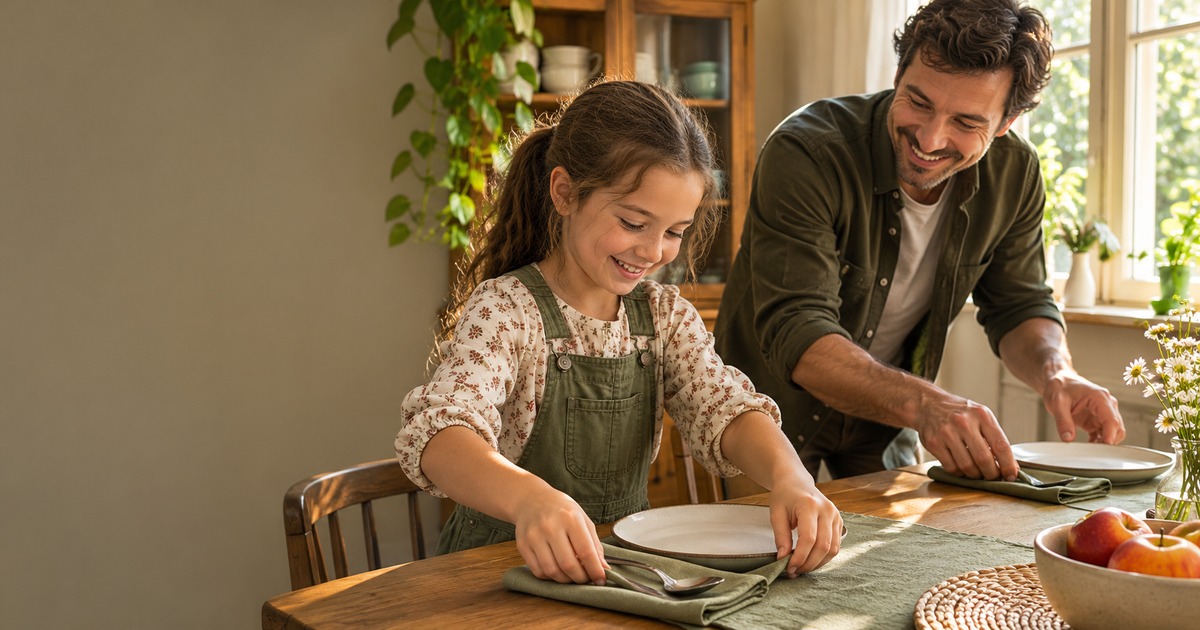
Dinner is nearly ready. You call out, “Can somebody set the table?” One child keeps reading, the other puts down two forks and leaves, and you finish the table while telling everyone they need to help more. Tomorrow the same request is likely to mean something different to each person again.
If you want to know how to get kids to help at home, start with one job, a clear cue, and a way for the child to see that their part is finished. “After you wash your hands for dinner, please put one napkin next to each plate” gives them something they can do. You can handle the hot dishes while they handle the napkins. Both jobs get dinner to the table.
Give your child a real job they can finish
Look for a task someone already needs to do. Sorting a pile of clean socks, putting books back in a low basket, or placing napkins at the table can all have a visible result. Choose a part that fits your child's ability, the materials they can safely use, and the time you have. If the full task needs more skill or access than they have, take that part yourself and give them a meaningful step they can complete.
The American Academy of Pediatrics advises introducing one responsibility at a time for school-age children who are new to chores, explaining what is expected, and adjusting if the load is too much. It also recommends routines and visual reminders. Pick a cue the child already recognizes, such as finishing a snack or putting pajamas on, and keep the tools close to where the job happens. AAP guidance on age-appropriate chores.
Decide how you will know the work is finished. “Help with laundry” might mean the whole basket to you and two socks to your child. Try “pair the socks in this pile and put any extras in this bowl.” If a sock is missing, they can finish the part they were asked to do. If something really needs to be fixed, describe that specific part. “Put the matched pairs in the drawer” gives the child useful information.
Give one instruction and leave time to start
Move close enough to be heard. If the child is in the middle of a game or reading a page, acknowledge what they are doing and give a timing cue you can keep. “Finish the page, then put the napkins beside the plates” is easier to act on than a request repeated from another room. If the job has to happen right now, say so directly and point to the first item they need.
For toddlers and preschoolers, the CDC recommends clear, specific directions, one at a time, using a calm tone. For an older child, you can agree on the job ahead of time and use a shorter reminder at the moment. If you offer a choice, make both options workable. “Napkins tonight or books after dinner?” is a real choice when either job helps. CDC tips for giving directions.
Give the child time to act after the request. If they seem unsure, check what they heard. They might be waiting for a plate to appear, or they may know where the napkins go but be unable to reach the drawer. Show one example, lower the basket, or start the first step together. Then let the child finish the part they can do.
Look for the step where the job gets stuck
| What you see | What to try | What to say |
|---|---|---|
| They start and stop after the first item. | Make the endpoint visible or show one example. | “One napkin next to each plate. There are two places left.” |
| They ask where things are every time. | Keep the items in a reachable, consistent spot. | “The napkins are in this basket. Can you show me where we’ll keep it?” |
| The request always comes during the same activity. | Choose an earlier cue or an agreed stopping point. | “After this round, it’s time for the napkins. I’ll put the plates out now.” |
| They can do one part, but the rest overwhelms them. | Divide the job into parts and take the harder one. | “I’ll carry the dishes. Please collect the cloth napkins.” |
| Two children argue about whose job it is. | Give each a separate role and agree on swaps ahead of time. | “You take the napkins tonight. Your sister will put out the spoons.” |
Notice patterns before changing the whole routine. If a child usually helps but misses the job on practice nights, try moving their contribution to a different part of those evenings. If the same instruction works with one adult and stalls with another, compare the words and the cue. Everyone may be asking for a different version of the job.
Keep the expectation clear when a child says no
Give a short acknowledgment and restate the job. “You want to finish your drawing. The napkins still need to go on the table. Do you want me to put the basket here or beside the plates?” If the child says they cannot reach something, fix that first. If everyone's getting louder, pause the discussion and keep the immediate routine going. Decide how to practice the job again when you have time.
Sometimes the adult needs to finish the task. Dinner may be getting cold, or there may be a spill that needs immediate attention. Say what you are doing and when the child can take their part again. “I’ll get the napkins now so we can eat. Tomorrow I’ll put the basket out after snack and you can set them up.” Use the next attempt to make the earlier cue happen.
When the job is done, describe what helped. “Thanks for making sure everyone had a napkin. We could sit down together.” If there is a minor difference in how a napkin is folded, leave it if it still works. Showing children where the standard matters can make the next instruction easier to understand. Keep feedback about the particular action and the effect it had on the people sharing the space.
Worked example of setting the table on a busy evening
Imagine a family with two children, a parent serving food, and a second adult arriving just before dinner. The younger child is asked to set the table while watching a show, and the older child believes they have to do it any time their sibling forgets. The family decides to change one thing at a time. For the first few evenings the only new job is putting out the napkins. They keep the basket by the place mats and the adult sets out the plates.
On the first evening, the parent demonstrates one place and asks the younger child to do the remaining ones. The older child has a separate role after dinner, collecting the used cloth napkins into a basket. The family explains both jobs before the meal. On practice night, the older child comes home later, so the adults agree ahead of time to handle collection that day. The younger child's job remains the same.
On the third evening, the younger child starts after the usual cue but leaves two napkins in the basket. The parent points to the two uncovered places and gives the child a moment to finish. They notice that the youngest can see all the places from one end of the table, so they move the basket there. At the end of the week, the child says the basket matters more than the spoken reminder. The family keeps the basket visible and tries waiting before offering a cue.
Make contributions workable across siblings and different days
Explain who handles each job and where a child can ask for help. A younger child might put away the napkin basket while an older child puts away the place mats. Some children may use a picture of the finished table or a short checklist. If one sibling frequently finishes the other's work, change the handoff. Let the child who needs support pick a smaller step, and have an adult handle the remaining part.
Review the total effort, including school and other responsibilities, when someone says the arrangement feels unfair. Agree to rotate a job if each child can do it safely. If only one person can handle a particular part, find a different way for the other child to contribute. Write down any regular changes for late days, visits between households, or evenings with a different caregiver. Keep the plan short enough to use at the moment the job starts.
If your family wants a visual reminder, add the job to a chart after you have worked out the cue and the finish line. A picture in the place where the work starts can be enough. A chart helps when it answers a question such as “whose turn is it?” or “where does this go?” Famello’s guide to building a chore chart.
Plan for the days the job needs to change
Some evenings are too crowded for the usual arrangement. Choose a small version of the task and say who will do the rest. If dinner is a quick meal before practice, the child can put out the two napkins needed now, and the adult can set up later for everyone else. On a day when the child is ill or exhausted, make a temporary handoff and say when you will check in about the routine again.
Use the same approach when a job becomes easier. If the child starts getting napkins without a reminder, ask whether the basket is enough of a cue now. Let them tell you when they want help. Before adding another job, check that the child has seen you do it and can tell what they are responsible for. Give the new part a practice run while you are nearby.
Agree on one way to tell another caregiver about the plan. A note beside the basket can list the cue and the part the adult handles. If you discover that the plan worked differently when you were away, ask what helped. A change that was made for convenience may be easier to repeat than the original routine.
Copy this one-week household-help worksheet
Fill in one line per question with your child. Pick one job to practice over the week. If the routine only happens twice during that week, think of each attempt as a chance to learn one thing about how the job fits the day.
- The job our family needs help with: _____
- Who does each part: _____
- The cue that tells us it is time: _____
- Where the tools or supplies live: _____
- What finished looks like: _____
- What an adult will help with: _____
- Who handles it on a busy day: _____
- One thing that got easier and one change to try: _____
At the end of the week, ask “What helped you know when to start?” and “Which part would you change?” You might hear that the cue came during the wrong activity, or that a sibling kept moving the basket. Use the answer to make one adjustment. If the job fits and your child can do it consistently, keep it for another week before adding anything. A steady, visible contribution is enough to start.