Affiliate disclosure: This article contains Amazon links. As an Amazon Associate we earn from qualifying purchases, at no extra cost to you.
“Clean your room” sounds like one instruction to an adult. To a child standing among clothes, books, toys, cups and half-finished projects, it can feel like twenty decisions with no obvious starting point. The fastest way to reduce the argument is to make the job smaller, more concrete and easier to finish.
The goal is not a bedroom that looks staged every day. The goal is a room your child can reset with a routine they understand. That means agreeing on what “done” looks like, putting belongings where the child can actually reach them and teaching one repeatable order instead of issuing a broad command.
First, define what “clean” means in your home
A child cannot reliably meet a standard that changes depending on the adult’s mood. Choose a short minimum standard and use the same words every time. For many families, a finished room means:
- the walking path and doorway are clear;
- dirty clothes are in the hamper;
- food, cups and rubbish have left the room;
- toys, books and school items are in their assigned homes; and
- the bed is usable, even if it is not perfectly made.
That is specific enough to check and limited enough to complete. Decide separately whether dusting, vacuuming and changing sheets are part of the child’s routine, a shared household job or an adult task. Mixing every maintenance job into a daily tidy makes the finish line keep moving.
Do one adult-led reset before expecting independence
If the room contains more possessions than the storage can hold, no cleaning routine will solve it. Begin with a one-time reset together. Remove dishes and rubbish, gather laundry and return items that belong elsewhere. Then sort what remains into keep here, move elsewhere, donate and decide later.
Use a small “decide later” container with a review date rather than forcing a decision about every sentimental object. The container prevents indecision from stopping the whole reset. Avoid secretly discarding a child’s belongings; it may make future cleanups feel unsafe and turn every object into something that must be defended.
During this reset, observe where clutter repeatedly lands. A pile is often information. Clothes beside the bed may mean the hamper is too far away. Books on the floor may mean the shelf is packed or difficult to reach. School papers on a chair may need one tray near the door.
A child cannot tidy storage they cannot use
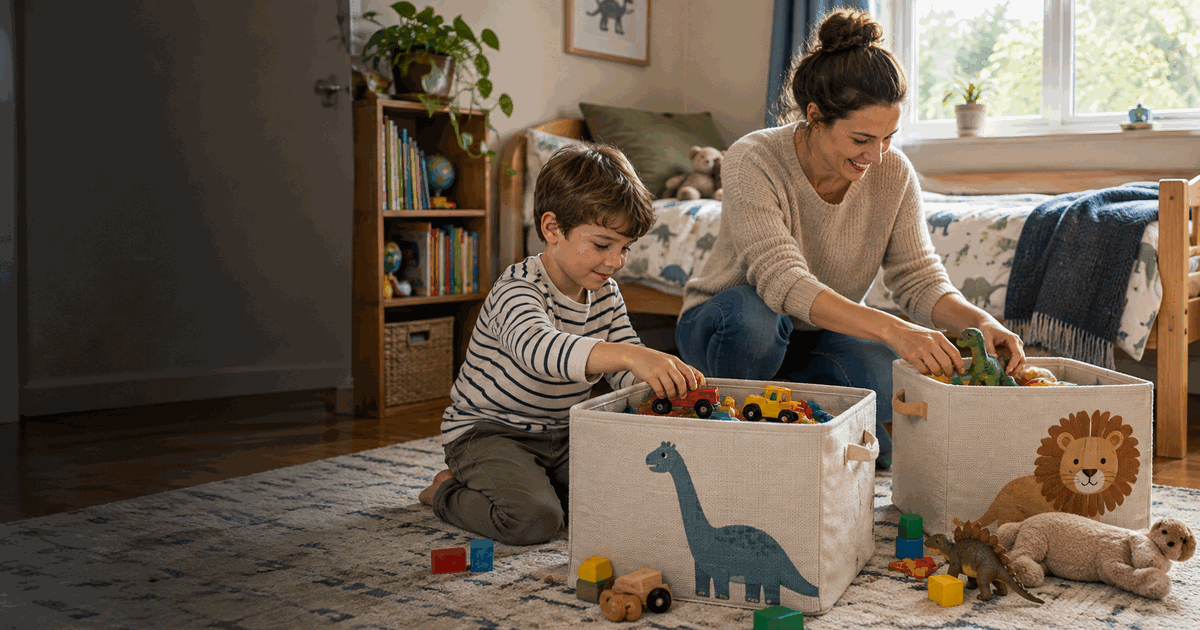
Storage should match the movement you are asking for. Open bins usually require fewer steps than lidded boxes. A low hook can be easier than a hanger. Picture labels can help a child who is not yet reading, while broad word labels such as “building,” “art” and “soft toys” create fewer decisions than many narrow categories.
Keep frequently used items between the child’s knee and shoulder height when practical. Put occasional or adult-supervised items higher up. Leave some empty space in each container so putting an item away does not require rearranging everything first.
The Humble Crew 12-Bin Toy Storage Organizer is one open-bin option to compare when the main problem is toys that have no reachable home. The manufacturer describes eight standard and four large removable bins on four tiers, with an overall size of 34 inches wide by 31 inches high. Check the exact listing and your available floor space before buying. We have not independently tested this organizer.
Open, removable bins can give frequently used toys a visible, reachable home.
Paid link: We may earn a commission if you buy through this link.
Check price on Amazon →You do not need new furniture to use the same idea. Reuse sturdy open containers, remove unnecessary lids or place one basket where the recurring pile already forms. For any freestanding storage, follow the manufacturer’s assembly and anchoring instructions. The U.S. Consumer Product Safety Commission recommends anchoring furniture to help prevent tip-overs in homes where children live or visit.
Teach the same five-step room reset
Give the cleanup a fixed order. The order removes the question “What do I do next?” and produces visible progress quickly.
- Remove: take out rubbish, dishes and anything that belongs in another room.
- Collect: put dirty clothes in the hamper and clean clothes in one place.
- Clear: pick everything up from the floor and bed, grouping similar things together.
- Return: put each group into its home: books, toys, school items and personal items.
- Finish: clear the doorway, straighten the bed and check the agreed definition of done.
Teach this sequence while working beside your child the first few times. Say the step aloud, do one example, then hand over the next item. Gradually reduce your help: first work together, then stay nearby, then check only at the end. Independence comes after the routine is learned, not before.
The reusable room-cleaning checklist
Copy this table onto paper or a small card and keep it inside the room. A visible checklist lets the routine carry the instruction so the adult does not have to repeat it from the doorway.
| Step | Action | Done when |
|---|---|---|
| 1. Remove | Rubbish, cups and items for other rooms | They are out of the bedroom |
| 2. Collect | Dirty clothes and clean clothes | Laundry is contained; clean clothes have one place |
| 3. Clear | Floor and bed | The walkway and sleeping space are usable |
| 4. Return | Books, toys, school gear and personal items | Each broad group is in its assigned home |
| 5. Finish | Quick visual check | The family’s minimum standard is met |
For a child who finds written lists difficult, replace the words with five photos of the actual room: an empty rubbish bin, the hamper, a clear floor, labelled storage and the finished bed. The photos should show your real standard, not an ideal room from the internet.
Use a short reset before the room becomes overwhelming
A ten-minute reset done regularly is easier than a long weekend rescue. Attach it to something that already happens, such as before the evening routine, after homework or before weekend screen time. Use a timer as a neutral boundary, not a threat.
At the beginning, choose one measurable target for the timer: clear the floor, empty the chair or return all books and toys. If the timer ends before the room meets the minimum standard, notice why. The problem may be too much stuff, a missing storage home, unclear directions or a task that is too large for one session.
Do not keep extending the timer without warning. A ten-minute promise that becomes forty minutes teaches the child not to trust the routine. Stop, identify the remaining job and schedule a separate shared reset if needed.
Match your help to the skill, not just the child’s age
Children develop planning, sorting and task-starting skills at different rates. A younger child may manage one category at a time: “Put every book in this basket.” A more experienced child may follow the full five-step card. A teenager may need agreement about hygiene, shared-home rules and a clear deadline while retaining more control over personal organization.
Break the work down when a child is learning, tired or already overwhelmed. You can point to the next step, carry items to another room together or make two piles while the child chooses where they belong. This is teaching support, not doing the whole job forever. Reduce one kind of help after the child can complete that part reliably.
Replace repeated commands with a calm script
Broad criticism invites an argument about character. A concrete prompt keeps the conversation on the task. Try:
- “The room reset needs to happen before dinner. Do you want to start with laundry or the floor?”
- “I see the hamper is full. Emptying it is the first step.”
- “Your five-step card says remove, collect, clear, return, finish. Which step are you on?”
- “The floor is clear and the books are away. The remaining job is clean clothes.”
Offer limited choices about order, music or whether you stay nearby. Keep the non-negotiable part simple: the agreed minimum needs to be complete by the agreed time. Avoid lectures during the cleanup. If a bigger conversation about respect or responsibility is needed, have it later when everyone is calm.
Use logical consequences instead of surprise punishments
A logical consequence is connected to the room problem. If art supplies are left uncapped, they are put away until there is time to use them with a cleanup plan. If the floor is not clear, a new activity waits because there is no safe working space. If laundry misses the family collection time, the child may need to wait for the next load or help run an additional load according to your household’s supervision rules.
State the consequence before the deadline when possible. Avoid throwing belongings away, taking unrelated privileges indefinitely or changing the rule after the child has started. Consistency makes the routine predictable; intensity usually adds emotion without teaching the missing skill.
A worked example: the room with no visible floor
Imagine a room with clothes beside the bed, building pieces across the floor, books on a chair and school papers on the desk. Instead of saying “This place is a disaster,” the adult uses the five-step reset.
First, cups and rubbish leave the room. Second, all clothes go into the hamper or onto the bed for a quick clean-versus-dirty decision. Third, building pieces go into one temporary basket so the walking path appears. Fourth, books return to the shelf and school papers go into a single tray. Fifth, the bed is cleared and the doorway checked.
The reset also reveals two system problems: the hamper needs to move beside the bed, and the building set needs a larger open container. Fixing those two points makes tomorrow’s cleanup shorter. That is the real purpose of the routine: not merely restoring the room, but learning why it became difficult to restore.
When the routine keeps failing
Pause before assuming defiance. Ask what happens between hearing the instruction and starting the work. Does your child know the first step? Can they see where items belong? Is the room overfilled? Is the request arriving during a hard transition? Can the job fit the time available?
Change one condition and test it for a week. Move the hamper, reduce categories, use a photo checklist, start together for two minutes or schedule the reset earlier. If everyday organization, attention or task-starting causes significant difficulty across home and school, discuss the broader pattern with the child’s teacher or a qualified health professional rather than treating the bedroom as a moral test.
The standard to keep
A child-owned room can show personality and still meet family standards for hygiene, access and care of belongings. Aim for a routine that is clear enough to repeat on an ordinary day. Teach the order, repair the storage problems and notice specific progress: “You started without another reminder,” or “You found a home for every book.”
A room will become messy again because it is used. Success is not keeping it permanently perfect. Success is giving your child a reliable way to bring it back.