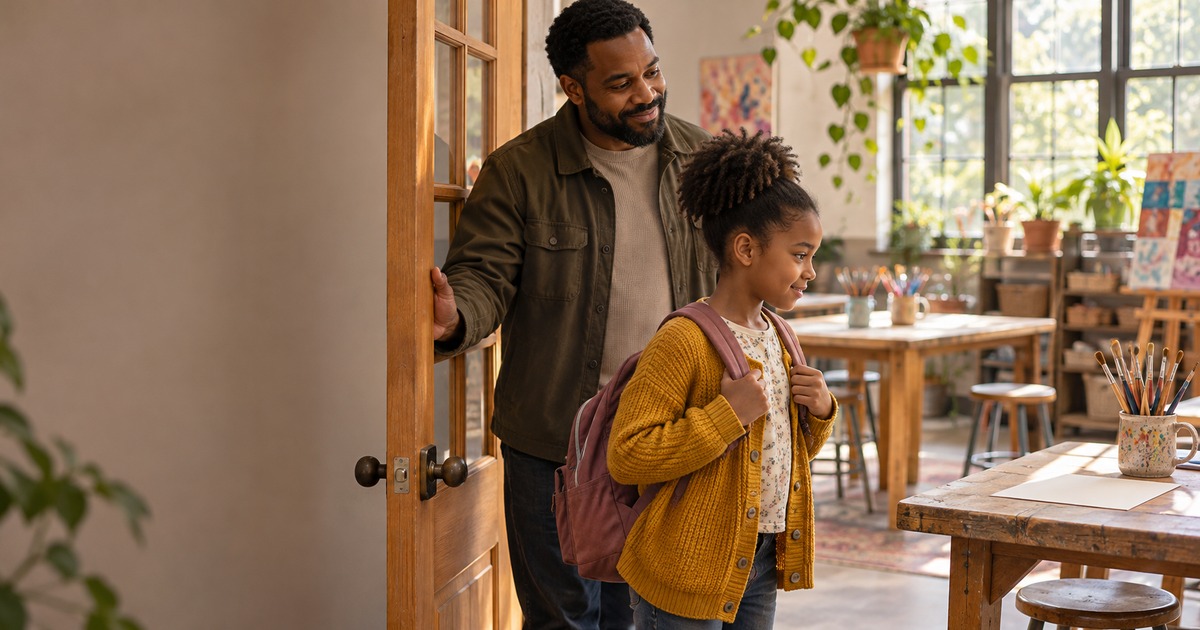
“What if I walk in and everyone is already drawing?” Your child has asked twice about the first art class. You know where the class is, but you cannot promise who will be there or what they will be doing. You can tell your child who will meet them, agree on what to do at the door, and work out how they can ask for help.
To help kids with new situations, give them enough information to get started. Acknowledge the worry, answer questions you can answer honestly, and choose a first step they can manage with support. If the same worry comes back, return to that step together. Keep the conversation open if your child tells you something new.
Find the part of the situation that feels hard
Ask one specific question at a calm moment. “Which part feels hardest right now?” If that feels too open, ask whether it is getting through the door, talking to someone, or knowing when you will be back. For a child who prefers to point or draw, make a simple sketch of arrival, the activity, and pickup, and ask which part needs a clearer plan.
Listen for practical concerns. A child who asks whether you will stay may be worried about finding the restroom or having to ask a stranger for help. Find out who can show them where to go. If an unfamiliar room will be loud or crowded, ask the organizer about arriving early or using a quieter entrance. Share the answer in a form your child can use, such as a photo of the door or the name of the person who will meet you.
The NHS recommends talking through upcoming changes, acknowledging children's worries, and finding ways to help before asking a child to face a stressful situation. Keep familiar parts of the routine where you can. For example, eat the usual after-school snack before leaving for the first class. NHS guidance on anxiety in children.
Give clear answers and offer steady support
Comfort can be a hand to hold, a quiet minute together, or a reminder about who will be there to help. If you hear yourself promising that everyone will be nice or that your child will love the class, replace the prediction with a fact or a plan. For instance, you know who is teaching. If your child wants to watch first, you can ask the teacher whether that is possible.
Boston Children's Hospital recommends acknowledging feelings and expressing confidence in the child's ability to cope, while avoiding excessive or false reassurance. Apply that advice to the part of the situation your child can actually take on. “You can tell me if you want me to ask with you” gives them a clearer option than “You'll be fine.” Boston Children's Hospital's parent guide to managing anxiety.
| What you hear | What you can say | What to do together |
|---|---|---|
| “Where do I go when we arrive?” | “We'll check in at the desk beside the stairs.” | Look at a photo or map, or ask the organizer where to start. |
| “What if nobody talks to me?” | “It's hard to walk in when you don't know anyone. We can ask the teacher where to sit.” | Agree on whether you will ask, they will ask, or you will ask together. |
| “Are you sure you'll come back?” | “I'll meet you at this desk when the class ends. If the plan changes, the teacher will tell you.” | Confirm the pickup plan with the adult in charge and make it easy to remember. |
| “Someone hurt me there last time.” | “I'm glad you told me. Let's find out what happened and who can help.” | Check the concern with the responsible adult and agree on a safe plan before returning. |
When a question repeats, check whether there is a missing detail. “Is there something about pickup we haven't figured out?” If the plan is clear and the worry is still there, offer to look at the plan together or sit with them for a moment. Keep your answer short enough that the child can remember it at the door.
Choose a first step your child can describe
“Join the class” covers several different tasks. You have to find the room, enter, greet someone, and figure out where to sit. Pick the part to work on first. If the child knows exactly where the room is but dreads choosing a seat, a walk past the building solves the wrong problem. Ask the teacher to show them a spot when they arrive.
- Name the step. “We'll go to the door and say hello to the teacher.”
- Agree on the support. “I'll stand beside you. You can wave or ask me to say your name.”
- Decide what happens if they need a pause. “Point to the bench and we'll sit there for a minute.” Check in together before deciding what to do next.
- Keep the agreement. If you promised to stay at the door, check with your child before you move away. Give advance notice if the venue has a different rule.
Some children will want to go further once they see what is happening. Others may need to repeat the same arrival plan several times. If your child manages the first step, describe what they did. “You asked where to put your bag, and the teacher showed you.” That gives them something specific to remember the next time they walk into a new room.
Keep accommodations that make the activity accessible. A visual schedule, familiar communication tool, hearing protection when appropriate, or quieter arrival can be part of the plan. Ask the child and the adults who know the setting which supports fit. Chelsea and Westminster Hospital's guidance on preparing for transitions.
Worked example of a first art class
Imagine your child wants to try an art class but worries the group will start before they arrive. You ask the teacher what the first few minutes look like. In this example, the teacher greets children at the doorway and offers a choice of seats, including one near the entrance. The organizer confirms that a parent can stay for the introduction. You tell your child these details and let them choose whether to wave or say hello.
At the door they ask again, “What if they're already doing it?” You say, “They might have started. We can ask the teacher where to begin.” Your child points toward the bench. You take a short pause there, and then they decide they would like you to ask the teacher together. The teacher shows them where the paper is. They choose to sit near the entrance and watch for a while.
Later, while you are walking home, ask which part helped. If the child says it was seeing the paper laid out before sitting down, ask the teacher if you can do that again. If the doorway was still too crowded, find out whether there is a quieter arrival time. Use that information to revise one part of the next visit.
Change the preparation to fit your child
When a picture works better than an explanation
Take one photo of the entrance and one of the place where you will meet afterward, if you are allowed to take photos there. Look at the photos in the order your child will see them. For some children, three drawings on a scrap of paper are enough. Leave space to add a change. You can cross out the first meeting place and draw the new one together if plans move.
When your child wants privacy
An older child may prefer to decide on a quiet signal or a text they can send if they need help. Agree in advance on what you will do when they use it. They may want you to wait nearby, ask a question discreetly, or collect them at an agreed spot. Check the venue's phone rules and agree on an in-person option if they cannot use a phone.
When there is no time to rehearse
Give a brief description of what happens next and identify one person who can help. Ask your child if they want to watch from the doorway or have you introduce them. Save the longer conversation for later, when you both have time to sort out what felt unfamiliar.
Copy this plan before a new activity
Fill it in together. Use the child's own words for the worry and keep the answers short. Take a photo of the plan or tuck it in the bag if the child wants to bring it.
- What's new: _____
- The part I want to know more about: _____
- What we know about arrival, the activity, or pickup: _____
- The person I can ask for help: _____
- My first step: _____
- The help I want for that step: _____
- How I can ask for a pause: _____
- What helped, and what I want to change for next time: _____
For a school visit, the first step could be walking from reception to the classroom with a staff member. For a family gathering, it might be choosing a familiar person to greet first. When you do not know an answer, give the question a place in the plan. Write down who will ask, when they will ask, and how you will tell your child what you learn.
Adjust when the plan changes
Say what changed and what you know now. “The class moved upstairs. The same teacher is meeting us at the desk.” If the pickup adult has changed, name the person and confirm that the child and staff know what to expect. Give your child a chance to change their first step, too. They may want you to walk upstairs with them before saying hello.
If the new information involves bullying, an unsafe setting, or a barrier to participation, follow up with the people responsible for the activity. Ask for a practical change, such as a supervised handoff or an accessible room. If your child is distressed in the moment, help them find a calmer place before asking them to talk through the details.
Know when to get extra help
If worries are intense, persist, or interfere with sleep, school, friendships, or other usual activities, talk with your child's pediatrician or primary care clinician. If school is affected, also speak with a teacher or school support staff. Share a recent example, how often it happens, what the child says is hardest, and which supports have helped. American Academy of Child and Adolescent Psychiatry guidance on anxiety in children.
For the next new activity, start with the question your child actually asks. Give the answer you know, find out what is missing, and choose one thing you can do together when you arrive.