Affiliate disclosure: This article contains Amazon links. As an Amazon Associate we earn from qualifying purchases, at no extra cost to you.
You sit down at dinner. You ask, “How was school?” You get “fine.” You try, “What did you do today?” You get “nothing.” Five minutes later everyone’s on their phone or asking when they can be excused. If this is your house most nights, the problem isn’t your kid — it’s the question.
Good family conversation starters do something that vague questions don’t: they give a kid a specific thing to remember, an opinion to defend, or an imagination to fall into. That’s the difference between a one-word answer and a six-minute story about something that happened at recess.
This guide is built to be useful tonight, not bookmarked and forgotten. You’ll get 40 ready-to-use conversation starters by category, a short framework for spotting questions that work (so you can come up with your own), and a few small habits that turn this from a one-night novelty into how your family actually talks.
Why “How was your day?” stops working around age six
Most parents have noticed the drop-off. Toddlers narrate everything. Five-year-olds will tell you about a bug they saw on the way to school in full breathless detail. Then somewhere around first grade, the floodgates close and “fine” takes over.
A few things are happening at once. Kids are starting to draw a line between “school me” and “home me,” and the question feels like a status report they don’t know how to give. The day has gotten complicated enough that summarizing it is genuinely hard. And open-ended questions ask kids to choose what’s worth saying — a skill that takes years to develop and a lot of energy to use after a long day.
The fix isn’t a deeper question. It’s a more specific one. “What was the funniest thing you heard today?” gives a kid a clear target. “If you could swap lunches with anyone in your class tomorrow, whose would you take?” gives them a decision to make. Both are easier to answer than “How was school?” — and the answer tells you about ten times more.
If you don't want to think up questions every night, a deck does it for you. A box of family conversation cards keeps the good questions coming without any prep.
135 family-friendly questions in a box — an endless supply of the kind of dinner-table prompts this post is full of.
Check price on Amazon →The 4 ingredients of a family conversation starter that lands
Before the list of 40, here’s the pattern underneath them. If you know what makes a question work, you’ll start inventing them yourself the moment the printed list runs out.
1. It’s specific. A good starter asks about a single moment, choice, or detail — not the whole day. “What made you laugh today?” beats “What was good about today?” every time.
2. It has a built-in answer hook. The best questions hand the kid the first few words of their reply. “If you had to teach the class one thing tomorrow, what would it be?” basically writes itself.
3. It can’t be answered with “yes,” “no,” or “fine.” Closed questions don’t cause silence on purpose — they just don’t make space for more. Open questions force a sentence at minimum.
4. It’s safe to answer. Kids talk when they’re sure they’re not being graded, fixed, or tested. Starters that ask for an opinion or imagination always feel safer than starters that ask for a feeling on the spot.
40 family conversation starters by situation
The questions below are sorted by when they tend to work best. Don’t feel locked in — a great bedtime question can land at the dinner table on the right night. Start with one from each section this week and you’ll already feel the change.
Dinner table starters (good for any age)
- What was the funniest thing you heard today — from anyone, even a stranger?
- If our dinner tonight had a name, like a restaurant special, what would you call it?
- What’s one thing that almost made you laugh today but you held it in?
- If you had to swap one thing about today with somebody else’s day, what would you trade?
- What was the hardest decision you made today, even if it was tiny?
- Who at school is the kindest, and what’s one specific thing they do?
- If you could invite one person who isn’t here to this dinner, who would it be and why?
- What’s a small thing that happened today that you think we should remember in a year?
Car ride and downtime starters
Side-by-side conversation is easier than face-to-face for a lot of kids — no eye contact, no pressure. The car, a walk, and tidying up together are some of the highest-yield talking moments in a week.
- If we could trade our car for any other way of getting around, what would you pick — and what would the downside be?
- What’s a song that always makes you want to skip it, and one that always makes you turn it up?
- If you got to design the perfect Saturday from scratch, what would the first hour look like?
- What’s the most boring thing you had to do this week, and was it secretly a little bit okay?
- If you had to give yourself a nickname based on this week, what would it be?
- What’s one rule at school you think is silly — and one you think is actually smart?
- If you found a hundred dollars on the sidewalk right now, what would the first thing you’d do with it be?
- What’s a question you wish I’d ask you more often?
Bedtime wind-down starters
Bedtime is when kids tend to crack open. The lights are low, the day is done, and there’s no audience. Pair these with a calm bedtime sequence — if you don’t have one, our bedtime routine for kids guide has a copy-and-paste flow.
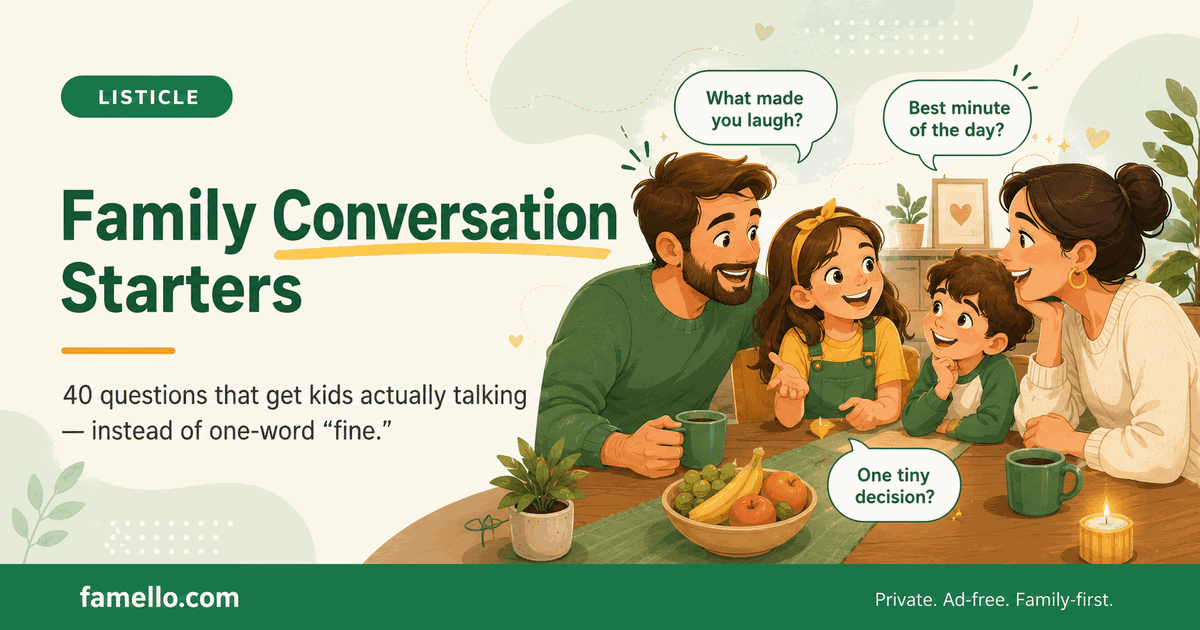
- What was the best minute of your day?
- Was there any part of today that felt harder than it looked from the outside?
- Who did you sit next to today, and what were they like?
- What’s one thing you’re a little bit looking forward to about tomorrow?
- If your day had a soundtrack, what song would be playing right now?
- What’s something you noticed today that nobody else seemed to?
- Is there anything you’ve been thinking about a lot lately?
- What’s one thing I could do tomorrow that would make your day easier?
Big-feeling and reflection starters
These go a layer deeper. Use them when there’s real time and a calm mood — a long car ride, a slow Sunday breakfast, a walk after dinner. They’re also great for a weekly family meeting or a shared family journal, where kids can answer privately first.
- When’s the last time you felt really proud of yourself? What was it about?
- What’s something you used to be scared of that doesn’t scare you anymore?
- If you could fix one thing about the world tomorrow morning, what would you start with?
- What’s a compliment someone gave you recently that meant a lot?
- What’s a mistake you made this month that you’d handle differently now?
- Who do you think really sees you the way you actually are?
- What’s something about being your age right now that you want to remember?
- If you could change one thing about how our family does things, what would you change first?
Funny and silly starters
Don’t skip these. The lighter questions are the ones that get used most often, and they earn the trust that makes the harder questions land later. A family that laughs together first will go deep together second.
- If our pet (or one of our pets) could talk for exactly one minute a day, when would you want it to be?
- What’s the worst possible flavor combination you can think of right now?
- If you had to wear one outfit for the entire summer, what would you pick?
- What superpower would actually be a terrible idea to have?
- If you were in charge of our family for a day, what’s the first rule you’d make?
- Which animal do you think has the most embarrassing life?
- What’s the strangest thing you’ve eaten on purpose?
- If you could put any one thing in a museum, what would it be?
How good is your starter? A quick quality check
If you want to write your own questions — or weed out the ones that always flop — here’s a fast scorecard against the four ingredients above. The high-quality column is where the real conversations live.
| Ingredient | Low-quality version | High-quality version |
|---|---|---|
| Specific | “How was your day?” | “What was the funniest thing you heard today?” |
| Has an answer hook | “Tell me something interesting.” | “If you had to teach the class one thing tomorrow, what would it be?” |
| Open, not closed | “Did you have fun at school?” | “What’s one thing today you’d do again tomorrow?” |
| Safe to answer | “Why are you in a bad mood?” | “If today were a weather report, what would the forecast be?” |
| Right moment | A heavy reflection question in the school drop-off line | A heavy reflection question at bedtime or on a slow Sunday walk |
You don’t need to score every question in real time — just notice the pattern. If a starter keeps getting one-word answers, it’s usually missing one of the first three ingredients. If a good starter still flops, check the fifth row: timing is half the battle.
How to make conversation starters a daily habit (not a one-night thing)
Most families read a list like this, try one good question on Tuesday, get a great answer, and then never do it again. Here’s how to make it stick past the novelty.
Pick one slot and protect it
Don’t try to add new conversation rituals to four different parts of the day. Pick the one moment that already exists — dinner, the school pickup ride, the last five minutes before lights-out — and put the question there. Predictability does most of the work.
Keep the list visible
The fridge, a card on the dinner table, a notes app on your phone, a daily task that pops up at 6:30pm — pick somewhere the question is going to find you, because you will absolutely forget otherwise. Many parents find that anchoring it to an existing routine works better than a standalone reminder.
Let kids ask, too
The fastest way to kill a ritual is to make it feel like an interview. Once a week, let a kid pick the question, or even write a new one. Kid-invented starters are often weirder and better than yours.
Don’t react to the first sentence
This is the one most parents get wrong. When a kid finally gives a real answer, the instinct is to coach, fix, or compare. Resist. A neutral “huh, tell me more about that” is the single highest-leverage thing you can do here. Save the advice for tomorrow.
Take the answer somewhere
If a question lands beautifully, write the answer down. Even one line in a shared family note or journal. You won’t remember it next month, and you’ll be thrilled to have it next year. This is the lazy parent’s shortcut to the time-machine effect a real family family journal gives you.
Where Famello fits in
Famello isn’t a chatbot or a question generator — the questions still come from you. What it does hold is the part that breaks first: the routine and the record.
You can set a recurring daily task called “Tonight’s question” (or anything you want) for whoever’s in charge of dinner, so the prompt actually shows up instead of getting forgotten. You can save the answers your kids give in the journal — one line, one mood, maybe a photo of the doodle they drew while answering — and end up with a quietly incredible record of how your family talks at this age. And because Famello is a private family space with no ads and no data sold, those answers stay between the people they belong to.
The free tier covers a family of four and unlimited journals, which is enough to run the whole ritual without paying for anything. Premium ($4/month) opens up unlimited habit history, the rewards system, and bigger family groups if you need them.
The bottom line on family conversation starters that work
You don’t need a curriculum, a card deck, or a podcast to get your kid to talk to you. You need three things: better family conversation starters than “how was your day?”, a regular moment to ask them in, and the patience to not pounce on the first interesting sentence that comes out.
Pick one question from the dinner list and use it tonight. Pick one from the bedtime list and use it on Friday. Notice which kid lights up at which kind of starter — that’s real information about who they’re becoming. Then keep going. Six months of small specific questions will change what you know about your kids more than any single big conversation ever will.
Keep the conversation going
Set a daily prompt, save the answers in a shared family journal, and build the kind of record you’ll thank yourself for in five years — all in one private, ad-free space.