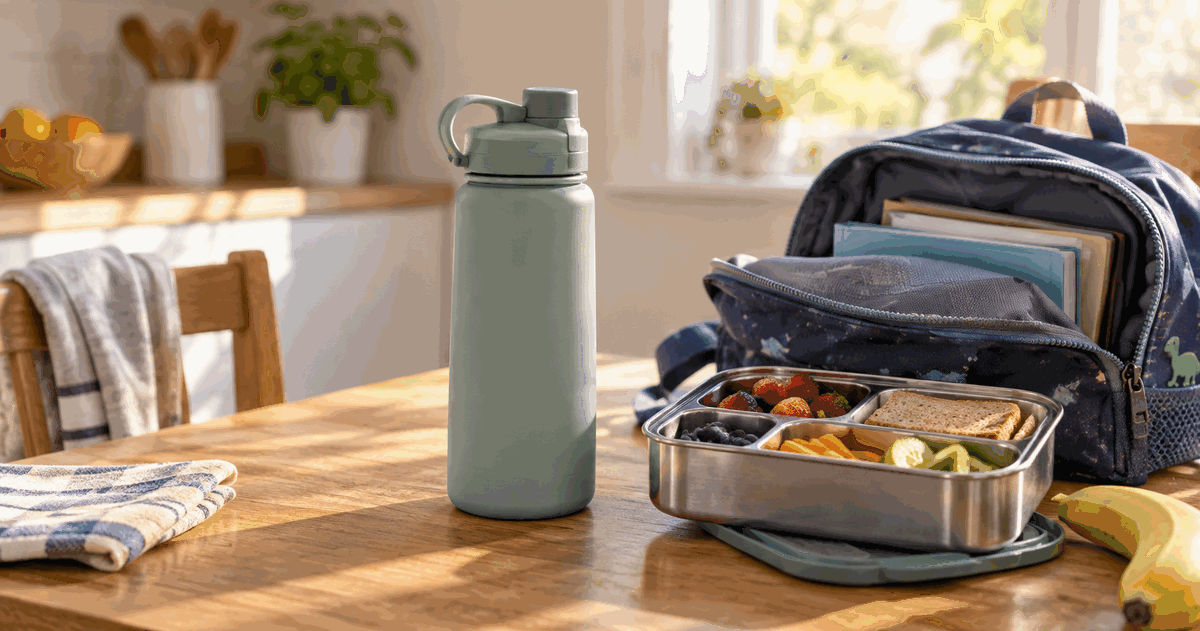
You unzip the backpack after school and the entire homework folder is soaked. The math sheet is a slow-drying square of pulp. The library book has that wavy, going-to-smell-forever page-edge. And the water bottle — the one that promised leak-proof on the box — is lying on its side in the main compartment, quietly emptying itself for the past three hours.
Every parent has a version of this story. It’s why searches for the best water bottles for kids spike every August, and why half the ones on the shelf at Target don’t survive the first semester. The difference between a bottle that works and one that leaves your kid dehydrated by lunch usually comes down to three things: the lid mechanism, whether the pieces can survive a dishwasher, and whether the size actually fits the side sleeve of a school backpack.
Here’s the honest guide — the bottles worth buying in 2026, the ones we’d skip, and the specific things to look at before you spend twenty-five dollars on something that’s going to live in your dishwasher for the next four years.
What actually makes a great kids water bottle
Before the picks, the checklist. Any bottle that fails one of these gets sent back inside a month:
- A lid that seals when the kid closes it wrong. Not when a careful adult closes it. When a distracted eight-year-old closes it one-handed while looking at a friend. Snap-shut spouts and screw-lock straws beat push-pull tops for this.
- Dishwasher-safe on the top rack — all pieces. Straws, valves, gaskets. If the lid says “hand-wash only,” it will grow mold by October. This isn’t a hypothetical.
- Fits the backpack side sleeve. Most elementary backpacks max out around a 3-inch diameter bottle. A wide-mouth 20oz stainless bottle looks great in the store and won’t fit the pocket.
- 16–18oz for elementary, 20–24oz for middle school. Bigger is not better — it’s heavier, harder to drink from, and refills at school are almost always available. The right size gets carried; the wrong size gets left at home.
- No hidden crevices. The more clever the lid, the more places bacteria hide. A simple straw beats a spring-loaded flip-top spring-loaded button assembly every time.
- A name a kid can find. Silicone name band, engraved lid, or a permanent-marker patch that survives washes. Every school has a lost-and-found bin full of unmarked stainless bottles.
Insulation matters less than you’d think. Cold water at 10am is nice; cold water at 2pm is nicer. But a plastic bottle that gets refilled at the fountain three times a day beats a stainless bottle sitting empty in the cubby because the kid didn’t want to carry the weight. Match the bottle to the actual kid.
Best water bottles for kids at a glance
The shortlist — six bottles families keep coming back to, sorted by the situation they actually solve.
| Bottle | Best for | Size range | Lid type |
|---|---|---|---|
| Contigo Kids AUTOSPOUT | The backpack survivor (ages 4–10) | 14oz | Snap-shut straw |
| Owala FreeSip Kids | Straw AND gulp in one lid | 16oz | Push-button flip lock |
| Hydro Flask 12oz Kids Wide Mouth | All-day cold, sports and camp | 12oz, 20oz | Straw lid (sold separate) |
| Simple Modern Summit Kids | Budget stainless with a straw | 14oz, 18oz | Straw + handle |
| CamelBak eddy+ Kids | Kids who chew the straw | 14oz, 20oz | Bite valve |
| Yeti Rambler Jr. | Middle-school and up, indestructible | 12oz | Straw cap |
The one that survives a backpack
If you’re here for one recommendation and one only — the bottle that gets tossed sideways into a backpack, sits in the horizontal position for four hours next to a math folder, and comes out dry — the Contigo Kids AUTOSPOUT is the one most elementary-school parents settle on.
The reason is the lid mechanism. It’s a snap-shut straw: the straw physically clicks down flush with the lid, and when it’s down, the bottle is closed. There’s no “did I twist it enough?” ambiguity. Either the button is down (sealed) or it’s up (open). An eight-year-old can hear the click. That’s the difference between a homework folder that stays dry and one that turns into pulp by 2pm.
The other reason it’s the survivor is that it comes as a two-pack. This sounds trivial until you’ve had the school-morning moment where the one water bottle is in the dishwasher on the second cycle because someone put yogurt in it yesterday. A backup bottle isn’t a luxury — it’s the thing that keeps the morning routine from collapsing on a Tuesday.
Snap-shut straw seals with an audible click a distracted kid can hear, dishwasher-safe on the top rack, and a 14oz size that fits the side sleeve of every elementary backpack we’ve tried. The two-pack matters — one bottle is always in the dishwasher, and mornings are much calmer when the backup is ready to grab.
Check price on Amazon →One honest caveat: the AUTOSPOUT is plastic, not insulated. Water goes room-temperature by lunch. If your kid needs cold water at 2pm — sports team, hot-weather school, kids who won’t drink warm water on principle — look at the stainless picks below. But for the pure backpack-survival problem, this is the bottle.
The straw-and-gulp compromise
Some kids want a straw. Some kids want to tilt the bottle back and gulp. The Owala FreeSip Kids has a lid that does both in the same opening — there’s a straw and a wider drink spout inside the same push-button flip-lock cap. It’s the answer for the kid who can’t decide, and for families with two kids sharing bottle styles.
The flip-lock is more secure than a push-pull spout but slightly less bulletproof than the AUTOSPOUT’s click-down straw. It’s the pick for kids old enough to check that the lock is closed — roughly six and up.
The stainless picks: when insulation matters
Three stainless bottles worth the money if cold water is a priority:
- Hydro Flask 12oz Kids Wide Mouth — the one that holds ice through the school day and into after-school pickup. Buy the straw lid separately; the standard lid is a screw-off wide mouth that a six-year-old will spill from every time.
- Simple Modern Summit Kids — roughly half the price of a Hydro Flask, comparable insulation, comes with a straw lid and a handle out of the box. This is the honest budget pick.
- Yeti Rambler Jr. — the middle-school and up option. Overbuilt, tank-heavy, and effectively indestructible. If your kid has already destroyed two bottles this year, this one ends that pattern.
All three are dishwasher-safe on the top rack (Yeti’s straw cap included), and all three fit standard backpack side sleeves in the 12oz size. The 20oz versions do not always fit — measure the pocket before you buy.
The chewers, the sports kids, and other edge cases
If your kid chews the straw — and a real percentage of kids do, especially under age seven — the CamelBak eddy+ Kids is the one built for it. The bite valve is a soft, replaceable silicone piece that’s designed to be chewed and pulled through. Replacement bite valves are five dollars for a two-pack, which is a lot cheaper than a new bottle every two months.
For sports practice specifically, look at anything with a wide mouth for ice cubes and a carrying loop. The Hydro Flask 20oz with the sport cap is the standard-issue soccer-mom bottle for a reason.
How to pick the right size
Size trips more families up than lid mechanism. The right size gets carried; the wrong size stays in the cubby.
- Pre-K to 1st grade: 12–14oz. Small hands, small backpacks, refills available at school.
- 2nd to 5th grade: 14–18oz. Fits a standard elementary backpack side sleeve. Enough to make it to lunch without a refill.
- Middle school: 18–24oz. Bigger backpack pockets, longer stretches between refills, kids who don’t want to look like they’re carrying a preschool bottle.
- Sports: Add 8–12oz to whatever you’d otherwise buy. A soccer practice in September heat drains a 16oz bottle in the first half.
The single best test: fill the empty bottle you’re considering, put it in the actual backpack, and have the kid carry it around the store for five minutes. If they set it down after ninety seconds, it’s too heavy.
Keeping the bottle from becoming a science experiment
The reason kids water bottles get replaced isn’t usually damage — it’s the black mold in the straw that no amount of scrubbing gets out. Three habits that keep a bottle usable for the whole school year:
- Dump and rinse every night, not every “when we remember.” A wet bottle sitting closed overnight is a petri dish. This is the single most important habit.
- Full dishwasher run twice a week. Top rack, lid disassembled, straw and valve separate. Sunday and Wednesday works for most families.
- Deep clean once a month with a straw brush. A pipe-cleaner-style brush is two dollars and reaches the places the dishwasher misses.
A shared family app makes the daily rinse actually happen — a small recurring evening task on Famello’s task list (“rinse bottles”) ticked off by whichever kid is closest to the sink is enough of a system to keep the mold at bay. Ad-free, private, nothing sold on.
Same energy as a tight back-to-school checklist that catches the small stuff before the first bell, or a after-school snack routine that means the water bottle actually gets refilled the second the kid walks in.
What to skip
A few categories worth walking past on the shelf:
- Any bottle with a push-pull spout as the primary seal. They leak. They always leak. Give it a month.
- Character bottles with stickers or graphics that peel. The graphic peels, the kid loses interest, the bottle gets replaced by January. A plain solid color the kid picks lasts longer.
- Anything “hand-wash only.” This is a promise no family keeps past week three.
- Extra-large 32oz bottles for elementary kids. Too heavy, too tall for the backpack pocket, and half the water goes home undrunk anyway.
- Bottles with electronic hydration trackers. A gimmick. The battery dies in six months.
Making the best water bottles for kids work past September
The August version of the water bottle situation is optimistic. New bottle, freshly labeled, in the front pocket of a clean backpack. The October version is a beaten-up bottle rolling around the main compartment with a chewed straw and a mystery smell.
Two small habits keep the September version alive:
- Label it the day it comes home. Silicone name band, engraved lid, or a permanent-marker patch on the base. Do it before the first day of school — not after the first trip to the lost-and-found bin.
- Keep the receipt for the first two weeks. If the lid mechanism fails, the leak shows up early. Return it before the school year gets serious — not in November when the receipt is gone.
And the two-bottle rule stays true through the year. One in the backpack, one in the dishwasher. If your household is running a single-bottle rotation by December, the mornings will tell you.
Best water bottles for kids: the short version
The best water bottles for kids in 2026 are the ones that seal when a distracted eight-year-old closes them, survive the top rack of the dishwasher, and fit the side sleeve of the actual backpack. For pure backpack survival on an elementary schedule, the Contigo Kids AUTOSPOUT is the one families keep coming back to — snap-shut straw, audible click, and the two-pack that means the morning doesn’t collapse when one bottle is in the sink. For cold water at 2pm, a Hydro Flask 12oz or a Simple Modern Summit Kids with a straw lid does the job. For chewers, CamelBak eddy+ Kids with replaceable bite valves. For middle-schoolers who’ve destroyed two bottles already, a Yeti Rambler Jr. ends that pattern. Match the bottle to the actual kid — the right size gets carried, the wrong size gets left at home — and dump it every night. The mold is what kills a bottle, not the drop from the lunch table.
The nightly bottle rinse is a five-second task that never happens without a nudge.
Famello is a private family journal, habit tracker, and task list in one calm space — add “rinse the bottles” as a recurring evening task and the whole family sees it get ticked off. Ad-free, nothing sold on.
Related reading: The honest back-to-school checklist · Healthy after-school snacks that actually get eaten · The best backpacks for kids (and the ones to skip) · Kids lunch ideas that survive until noon