Affiliate disclosure: This article contains Amazon links. As an Amazon Associate we earn from qualifying purchases, at no extra cost to you.
My daughter came home from kindergarten one Friday with the exact same lunch I’d packed her on Monday. Same crackers, same cheese cubes, same untouched carrot sticks. The apple had one bite out of it. The yogurt hadn’t been opened. This after twenty minutes of me chopping and layering that morning like a short-order cook.
The lunchbox coming home full is not a personality problem. It’s a signal — usually about presentation, portion, or one specific food touching another one. Picky kids are surprisingly consistent about what works, and once you spot the pattern the packing gets easier and the box comes home empty.
Here are the kids lunch ideas that hold up in a real backpack, the five-slot formula that removes the daily decision fatigue, and twenty specific lunchbox builds by age. No reheating, no sad wilted salad, no pretending your seven-year-old will eat quinoa.
Why picky kids don’t eat what you pack
Three things kill a picky kid’s lunch, and they’re almost never “the food is bad.”
The food touched. A ham sandwich resting on top of grapes turns both into rejects. To an adult that’s absurd. To a five-year-old it’s a real problem — textures crossed, one food is now “wet,” the whole box is contaminated. This is the single most common reason lunches come home uneaten.
The portion looks like too much. A giant sandwich cut in half is visually overwhelming. The kid opens the box, decides they can’t finish it, and eats the pretzels instead. Ten small things almost always beats two big things.
Nothing looks familiar. Lunch at school is stressful enough — new-food experiments belong at home on a weekend, not in a loud cafeteria with a 20-minute clock. If nothing in the box is a proven safe food, they will trade for chips.
The five-slot bento formula (works for every age)
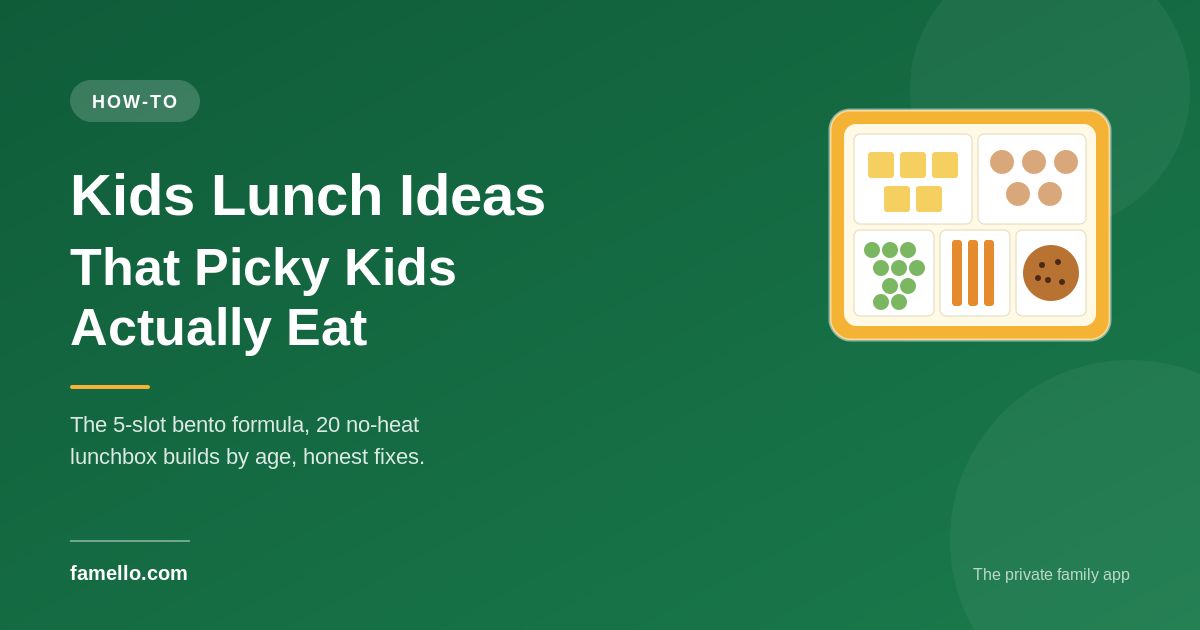
Skip the recipe hunting. Every good kid lunch fills five slots: one protein, one carb, one fruit, one veggie, one treat. Nothing touches. The treat isn’t a reward — it’s the anchor that makes the box feel “theirs” instead of “a healthy plate mom made.”
Once you have the formula, packing is a 90-second sort. Pull one from each column, drop it in a compartment, done. The variety comes from the columns, not from you inventing new lunches.
| Slot | Rotate between |
|---|---|
| Protein | Turkey roll-ups, cheese cubes, hard-boiled egg, hummus with pita, salami slices, chicken nuggets (cold is fine), sunflower butter, edamame |
| Carb | Whole-grain crackers, mini bagel, tortilla pinwheels, pretzels, brown rice cakes, English muffin, pasta salad, breadsticks |
| Fruit | Grapes (halved for under 5), apple slices with a tiny lemon squeeze, berries, mandarin, kiwi coins, watermelon cubes, mango, banana muffin |
| Veggie | Baby carrots with ranch, cucumber coins, bell pepper strips, snap peas, cherry tomatoes, roasted chickpeas, corn (leftover), edamame pods |
| Treat | Two dark chocolate chips, a small cookie, yogurt-covered raisins, a mini muffin, a fruit strip, popcorn, animal crackers |
Two rules that make this work in practice: one, always include at least one anchor food — something you know they’ll eat no matter what. Two, the new/experimental food (if any) goes in the smallest compartment. Small portion, low pressure.
The one tool that solves half the picky-eater problem: separate the foods
The single biggest packing upgrade isn’t a recipe. It’s the box. A proper compartment lunchbox — a bento — ends the food-touching problem in one purchase. Every food gets its own well, nothing slides into anything else, and the visual of five neat little slots turns lunch into something a kid actually opens with interest instead of dread. That’s not marketing; it’s just how five-year-olds work.
The one we keep landing on is the Bentgo Kids — five compartments, leak-resistant, drop-tested by real children, dishwasher-safe on the top rack. It’s not the fanciest option on the market; it’s the one that survives a school year of being flung into a backpack and still closes properly in June.
Five leak-resistant wells, kid-friendly latches, dishwasher-safe — the format that solves the “foods can’t touch” problem in one purchase.
Check price on Amazon →You don’t need this specific box, but you need a compartment box. A plastic bag full of loose grapes and a sandwich is where the trouble starts. The compartments do half the work of getting the food eaten.
20 no-heat lunchbox ideas by age
All of these follow the five-slot formula, all of them survive a morning in a lunchbox, and none of them require a microwave. Age ranges are honest — a 10-year-old will still eat the “5-year-old” lunches; a 5-year-old won’t handle the sushi.
Ages 4-6 (kindergarten lunch ideas)
Keep it small, familiar, and easy to open. A four-year-old with a screw-top yogurt tube will spend the whole lunch break wrestling with it and eat nothing.
1. Cheese cubes · whole-grain crackers · halved grapes · cucumber coins · two mini vanilla wafers
2. Turkey roll-ups (rolled around a breadstick) · pretzel sticks · strawberries · baby carrots + ranch cup · yogurt-covered raisins
3. Sunflower butter on mini rice cakes · banana · snap peas · a hard-boiled egg (shelled at home) · one small cookie
4. Chicken nugget dippers (cold, three of them) · ketchup cup · apple slices with lemon · corn kernels · a fruit strip
5. Mini bagel with cream cheese (packed separately, spread by them) · blueberries · cherry tomatoes · string cheese · two dark chocolate chips
Ages 6-9 (elementary school lunch ideas)
Portions grow, sandwiches enter the rotation, and this is the age they start noticing what other kids eat. If everyone has a Lunchable, occasionally packing a DIY version (see #7) buys you a lot of goodwill and is still much better than the boxed one.
6. Ham & cheese pinwheels (tortilla, rolled and sliced) · pretzels · grapes · bell pepper strips · animal crackers
7. DIY “lunchable” — round crackers, ham slices, cheese slices · grape tomatoes · apple slices · carrot sticks · a small cookie
8. Pasta salad (cooked pasta, olive oil, peas, parmesan) · a breadstick · watermelon · cucumber · a mini muffin
9. Hummus with pita triangles · salami slices · mandarin segments · cherry tomatoes · popcorn
10. Peanut/sunflower butter & jam on whole-grain (cut into 4 squares) · string cheese · strawberries · edamame pods · two chocolate chips
Ages 9-12 (bigger appetite, opinions)
Same formula, bigger portions, more interesting proteins. Involve them in the packing at this age — a 10-year-old who chose their own lunch eats their own lunch. Making them the co-packer is the fastest way to reduce food waste.
11. Chicken & cheese quesadilla wedges (cold, sturdy) · salsa cup · grapes · bell peppers · a small cookie
12. Turkey & avocado wrap (lemon on the avocado so it doesn’t brown) · tortilla chips · berries · carrot sticks · dark chocolate square
13. Bagel with cream cheese & smoked salmon · capers · cucumber · grapes · a mini muffin
14. Cold soba noodles with sesame oil · edamame · mandarin · snap peas · two squares of dark chocolate
15. Grocery-store sushi (California roll) · edamame · mango cubes · cucumber · a fortune cookie
Backup lunches for when you’re out of everything
Every parent needs a mental “we have literally nothing” template. Keep the ingredients on hand and you’ll never do the 10pm grocery run.
16. Pantry lunch — string cheese, crackers, applesauce pouch, baby carrots, animal crackers.
17. Breakfast lunch — hard-boiled egg, mini pancakes, strawberries, cucumber coins, yogurt tube.
18. Snack-plate lunch — hummus, pita, olives, cherry tomatoes, a mini muffin. (They’ll love this and think you’re fancy.)
19. Leftover-pizza lunch — cold slice (yes really), grapes, carrot sticks, cheese cubes, a cookie.
20. Bento charcuterie — salami, brie cubes, crackers, apple slices, dark chocolate. Age 8+, but a genuinely elegant emergency lunch.
Small tricks that make packed lunches actually get eaten
Cut the crusts, cut the sandwich into four small squares. Not because crusts matter — because a four-piece sandwich is four wins, and a two-piece sandwich is one big obligation. Small things get finished.
A tiny dip changes everything. Kids who won’t touch a raw carrot will eat six of them with a spoonful of ranch. Same for cucumbers with hummus, apples with sunflower butter, pretzels with cream cheese. The dip is the reason the veggie disappears.
Freeze the water bottle the night before. Doubles as an ice pack, keeps the cheese cold, and gives them very cold water at 11:30am. One less thing to pack.
Rotate three lunches, don’t invent daily. Kids like routine more than variety at this age. Pick three lunches your kid actually eats and cycle them Monday/Wednesday/Friday. Tuesday and Thursday can be the “stretch” lunches with one new food in the small slot.
Pack the night before. Morning packing is where sad lunches happen. Ten minutes after dinner while the kitchen is already messy is the single best packing window. Related: our morning routine guide has where lunch prep fits without derailing breakfast.
What to skip (even though the internet loves them)
Bento art. Sandwiches carved into pandas, apple slices arranged like flowers — beautiful, unnecessary, and the kid still doesn’t eat the “flower” parts. Save the time. A regular apple slice gets eaten just fine.
Thermos hot lunches for young kids. The thermos is heavy, the kid can’t open it, the food is lukewarm by 12:30, and it comes home wearing the mac and cheese. Wait until age 8 or 9 for hot lunches, or send those on days home.
Anything “deconstructed.” Deconstructed PB&J is just bread and jam in two cups. Deconstructed pizza is crackers, cheese, and sauce. Kids see through this immediately. Just make the actual thing.
Fancy character-shaped picks. The plastic picks the internet loves become choking hazards for under-4s and get thrown out at school. Skip them.
How to spot patterns in what comes home
The lunchbox is a small data source. If the fruit always comes home, the fruit isn’t working — try a different fruit or cut it differently, and cycle back to that one in a month. If the veggie always comes home, add a dip. If the carbs always come home but the protein disappears, they were hungry and the carbs got too full to finish.
A shared family notes list — even just a note on the fridge — makes this visible. Some families use Famello’s shared journal to keep a running “works / doesn’t work” list per kid, so both parents pack from the same information instead of relearning what she does and doesn’t eat this month. That’s the smallest possible use of the app, and it’s more useful than any recipe.
How Famello fits (quietly, not as another chart)
None of this needs an app. If it’s helpful, a few families use their private Famello family space to keep the running lunch rotation and the “what she ate this week” note in one place both parents can see. That’s the whole use case — no gamified stars for eating vegetables, no leaderboard of who packed the healthier box. Just less “wait, does she still like turkey?” at 7:15am.
It’s ad-free, private, and nothing about your kid’s food preferences gets sold to anyone. That’s the only reason to keep the note there instead of a public app.
The one thing to remember
A picky kid’s lunchbox coming home half-eaten isn’t a food problem. It’s usually a packaging problem — too much food, food touching, nothing familiar. Fix the format first (compartments, small portions, one safe anchor food) and the recipes barely matter.
Pick three lunches they eat, cycle them, add one new small thing on Tuesdays and Thursdays. Empty lunchbox by Friday, and neither of you cried over cucumber.
Keep your lunch rotation in one place both parents can see.
A shared “what she actually eats” list, a rotating three-lunch plan, and no more 7am guesswork — in one private, ad-free family space.
Related reading: A safe way to teach kids to cook, by age · Morning routine that survives contact with children · How to handle a picky eater without dinner-table battles · The after-school routine that doesn’t start with a meltdown