Affiliate disclosure: This article contains Amazon links. As an Amazon Associate we earn from qualifying purchases, at no extra cost to you.
Your kid loses a soccer game and the whole car ride home is sobs. Their best friend picks someone else for the partner project. They get a math test back with a red 62 at the top. You watch their face crumple and you feel that exact same crumple in your chest, because what you want to do — rescue, fix, distract, blame the teacher — is the opposite of what builds the muscle they actually need.
Knowing how to raise resilient kids isn’t about toughening them up or pretending the loss didn’t hurt. Resilience isn’t armor. It’s the quiet, learned belief that I can feel this bad thing, and I will still be okay on the other side of it. Kids build that belief from the inside out, and the strange part is they build it from the small stuff: zipping their own jacket, finishing the puzzle they almost gave up on, hearing you say “that was hard and you did it anyway.”
This is the real-life version — what resilience actually is, the 10 habits that build it without you having to be a perfect parent, and the daily structure that holds it all together.
What does it mean to raise resilient kids?
Resilience is the ability to recover after something hard — failure, disappointment, change, loss — and keep going. The American Psychological Association calls it “adapting well in the face of adversity, trauma, tragedy, threats, or significant sources of stress.” In a kid, you see it as the ability to:
- Try a thing, fail, and try again without falling apart.
- Feel a big emotion without being run by it.
- Ask for help when they need it — and try on their own when they don’t.
- Recover faster each time something doesn’t go their way.
A common myth: resilient kids are the ones who don’t cry. That’s not it at all. Resilient kids cry, and then they recover. The crying isn’t the problem — it’s the bounce-back that’s the skill. And the bounce-back is teachable.
Resilience is partly the voice a kid hears in their own head. A daily affirmation card is a small, concrete way to shape that voice one morning at a time.
A deck of 50 daily affirmations — a tiny, repeatable ritual that builds the inner voice resilient kids rely on.
Check price on Amazon →Resilient vs. fragile vs. tough: the difference matters
If you’ve been bouncing between books and TikToks, the categories blur. Here’s the clean version.
| Style | Feels emotions? | Recovers? | In one sentence |
|---|---|---|---|
| Fragile | Yes — intensely | Slowly, or not without rescue | “I can’t, this is the worst.” |
| Tough (suppressed) | Hides them | Looks fine, often isn’t | “I’m fine.” (Not fine.) |
| Resilient | Yes — and names them | Yes, with skill | “That sucked. I’m trying again tomorrow.” |
The goal isn’t the middle row. It’s the bottom one. Resilient kids feel everything — they just have somewhere to put it.
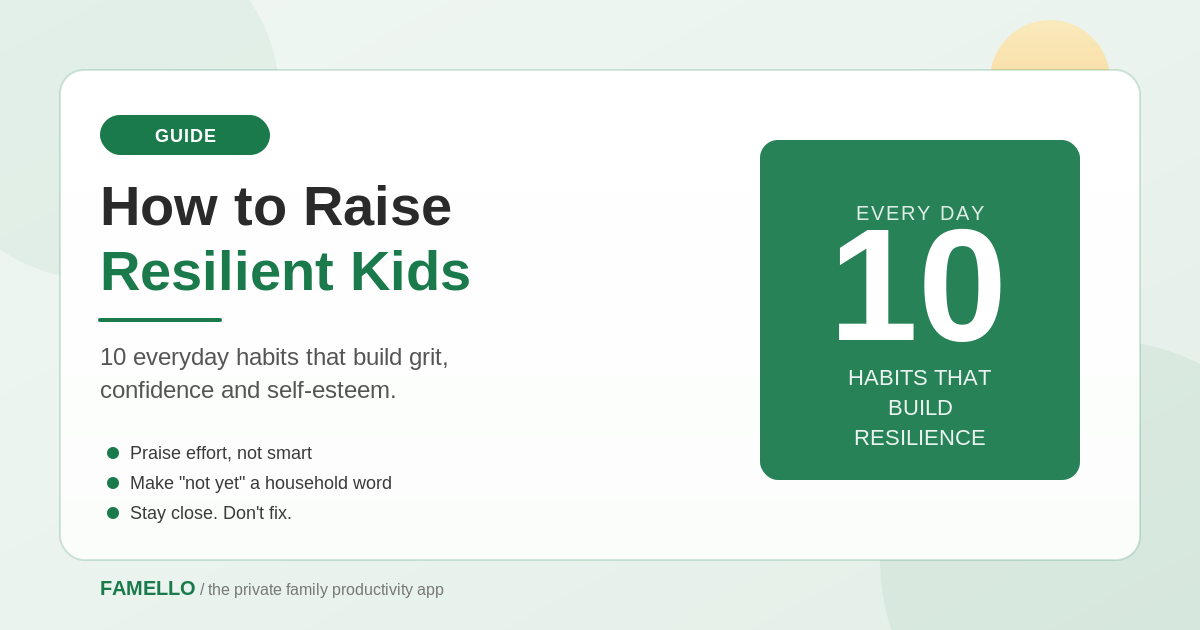
10 everyday habits that build resilience in kids
None of these are dramatic. That’s the point. Resilience is built in five-minute moments repeated for years.
1. Let them struggle for 30 seconds longer than feels comfortable
The instinct is to jump in — tie the shoe, open the jar, finish the puzzle. Try sitting on your hands for half a minute. Most kids figure it out. The ones who don’t, ask — which is its own skill.
Instead of: “Here, let me do it.”
Try: “I’m right here. You’ve got more in the tank than you think. Want one hint or do you want to keep trying?”
2. Praise the effort, not the outcome
Carol Dweck’s decades of research on growth mindset is unambiguous: kids praised for being “smart” avoid hard things (because failing would mean they’re not). Kids praised for trying hard tackle harder things. The shift is small and it changes everything.
Instead of: “You’re so smart!”
Try: “You stuck with that even when it got frustrating. That’s the move.”
3. Name “hard” out loud and normalize it
Kids decide whether hard things are dangerous by watching us. If you flinch every time something’s difficult, they learn difficulty is a problem. If you say “okay, this part is hard, that’s normal,” difficulty becomes a feature of being alive, not a sign something’s wrong.
Try: “Yeah — learning to ride a bike is the kind of hard where you fall a bunch. That’s how it works for everyone.”
4. Don’t fix what they can solve
If your kid forgets their water bottle, they have a thirsty day. If they forget their homework, they have an awkward conversation with the teacher. Natural consequences are the cheapest teacher available, and rescuing kids out of small problems robs them of the practice they need for the big ones.
This isn’t neglect — it’s restraint. You’re still the safety net for anything serious. You’re just not the autopilot.
5. Tell stories about your own failures
Kids think we always knew how to adult. Tell them about the job you didn’t get, the friend you fought with in fourth grade, the speech you bombed. Bonus points if you tell them what you tried next. You’re showing them what recovery looks like in a body they trust.
6. Make “not yet” a household word
“I can’t” closes a door. “I can’t yet” keeps it open. It’s a tiny addition that retrains how a kid thinks about ability over time. Use it on yourself out loud too — “I haven’t figured out how to fix this faucet yet” — so it sounds like a family value, not a kid-only rule.
7. Build small daily routines they own
Resilience grows out of competence, and competence grows out of repetition. A kid who handles their morning — clothes, breakfast, teeth, backpack, shoes — without you narrating every step has a quiet sense of I can run my own life that nothing else builds the same way.
This is one of the easiest places to start. Our full breakdown is in morning routine for kids, and the principle stretches to bedtime, homework, and weekends. A shared family app like Famello can hold the checklist so the kid owns it, not you. For more on that, see family habit tracker: streaks that build habits together.
8. Let them feel the feeling all the way through
Big emotions are not emergencies. When you stay calm next to your kid’s storm — not fixing, not shushing, just present — you teach them their feelings are survivable. That’s the bedrock of resilience. The talk afterward is optional. The presence isn’t.
If you want the longer version of this skill, our guide on emotional regulation for kids goes deep on the techniques.
9. Give them a job that matters
Kids who contribute to the running of a household — real chores, not pretend ones — develop what psychologists call “self-efficacy”: the sense that they have impact in the world. A four-year-old setting the table and a fourteen-year-old doing the family grocery run are running the same circuit. They’re needed. They count.
We wrote the full playbook on this in age-appropriate chores for kids.
10. Show them you recover too
You will lose your patience. You will have the bad day. The single most resilience-building thing you can model is what you do after: name it, repair it, move on. Kids who see adults recover learn that recovery is a thing humans do — not something only well-adjusted people are born with.
How to raise resilient kids by age
The principles don’t change. The script does.
| Age | What builds resilience | What undermines it |
|---|---|---|
| Toddlers (1–3) | Letting them try things slightly above their level. Naming feelings out loud. Predictable routines. | Doing every small task for them because it’s faster. |
| Preschool (3–5) | Pretend play with hard scenarios. Sharing your own “hard” in kid-sized words. Real responsibilities at home. | Rescuing them from every small friction at preschool. |
| School age (6–10) | Owning a routine. Trying a sport or instrument long enough to be bad at it. Problem-solving together. | Emailing the teacher every time something feels unfair. |
| Tweens (10–12) | Staying out of friendship drama unless it’s serious. Letting natural consequences land. | Fixing every social wound by becoming their lawyer. |
| Teens (13+) | Real-world responsibility — jobs, money, time. Staying curious, not lecturing. | Snowplowing obstacles so the path stays smooth. |
Resilience activities for kids you can start this week
If you want concrete things to do, not just principles, here are five that work across ages.
- The “hard thing” jar. Once a week, each family member writes down one hard thing they did and drops it in the jar. Read them at Sunday dinner. The jar quietly retrains the family to see hard as something you collect, not avoid.
- Storytime with stuck characters. Read books where the main character doesn’t get what they want and figures something out anyway. Pause and ask “what could they try?”
- One thing they do alone, once a week. Pay for the groceries. Order at the restaurant. Make the phone call to the dentist. Pick something age-appropriate that stretches them.
- The gratitude-and-glitch dinner round. Each person shares one good moment and one thing that didn’t go well today. The “glitch” part is where resilience lives — you’re modeling that hard moments are normal conversation, not shameful.
- A shared family journal. Even one line a day. A private space to write “today I tried, today I didn’t” turns life into something they can reflect on instead of just react to. Tools like Famello’s family journal with mood tracking give older kids a way to process feelings on paper instead of in your face.
What to drop if you want to raise resilient kids
Half of raising resilient kids is what you stop doing. Most parents reading this don’t need to do more — they need to do a little less, in the right places.
| Stop doing | Start doing |
|---|---|
| Snowplowing every obstacle out of their way. | Letting them hit small walls while you stay close. |
| Telling them “you’re fine” when they’re clearly not. | Naming the feeling, then trusting them to move through it. |
| Praising results (“A+!”) instead of process. | Praising the trying, the strategy, the showing up. |
| Pretending you never struggle so they think you’re bulletproof. | Sharing age-appropriate stories of your own recoveries. |
Signs your kid is becoming more resilient
This stuff is slow. You probably won’t see the shift this week. Over months, you’ll start noticing things like:
- They try again after the first attempt fails — without you prompting.
- They can name what they’re feeling (“I’m frustrated”) instead of just exploding.
- The meltdown after a loss gets shorter each time.
- They come to you to talk it through, not just to be fixed.
- They volunteer to try the new thing — even when they might be bad at it.
Does this actually work?
The research base on resilience is broad and consistent. Harvard’s Center on the Developing Child has shown for years that resilience in kids is most strongly predicted by one factor: at least one stable, committed relationship with a supportive adult. That’s the foundation everything else sits on. Add in routines, age-appropriate responsibility, growth-mindset language, and emotional coaching, and you have what the field calls “protective factors” — the things that buffer kids through stress and help them come out the other side stronger.
None of it requires a perfect parent. All of it requires a present one.
How Famello supports raising resilient kids at home
Resilience is a relationship plus a structure. The relationship is on you. The structure is where a shared system helps.
Famello is a private family app built around the kinds of habits that quietly build resilience: shared routines kids can own (morning, bedtime, homework), a habit tracker with streaks so they see their own consistency, a family journal with mood tracking so big feelings have a place to land, and a points-and-rewards system so effort gets recognized — not just outcomes. No ads, no data selling, your family’s timeline stays private.
You can start free with one family group of up to four members, or upgrade to Premium for $4/month for unlimited history, unlimited family members, and the full rewards system. Either way, the point is to take the “remember to” out of your mouth and put it onto a shared screen, so the daily structure that builds resilient kids actually happens.
Build the daily structure resilient kids grow from
Shared routines, habit streaks, a private family journal — one calm, ad-free space. Free to start.
Frequently asked questions about raising resilient kids
At what age can you start building resilience?
Day one. A baby who learns that a cry is met with a response is already building the bedrock of resilience — the belief that the world is responsive. From toddlerhood on, every “you do it” moment, every named feeling, every survived disappointment adds to the bank.
Isn’t letting kids fail kind of mean?
No — rescuing them from every small failure is what’s mean over the long run, because it leaves them defenseless against the big ones. Letting a kid lose a board game, forget a homework folder, or sit with a friendship hurt is how they learn they can handle hard things. Stay close. Don’t fix.
What if my kid is naturally anxious?
Anxious kids can absolutely become resilient — in fact the work matters more for them. The key is small, repeated exposures with you as the safe base. Don’t make the world smaller to fit the anxiety; gently make their tolerance bigger. A therapist who specializes in childhood anxiety is worth the call if it’s interfering with daily life.
How long until I see a difference?
Weeks for tiny shifts, months for real change, years for the full shape of it. Resilience is compounding. Don’t look at next Tuesday. Look at what your kid does at sixteen because of the way you handle this Tuesday.
What if I’m not a resilient adult myself?
Then you get to grow alongside them, out loud, and that’s actually the most powerful version of this work. “I’m learning this too” is a stronger model than pretending you’ve got it figured out.
Start small. Resilience is built in Tuesdays.
You don’t teach a kid how to raise resilient kids-level resilience by giving them a speech. You teach it by letting them tie the shoe, lose the game, miss the friend, sit with the feeling, and come out the other side with you nearby but not in the way. Pick two habits from this list. Run them for two weeks. Notice what shifts.
The kid who can fall down and get back up isn’t made of something different. They were just given a thousand small chances to practice the move.
Want to keep going on the connection side of this? Try our guide on how to teach kids responsibility next.