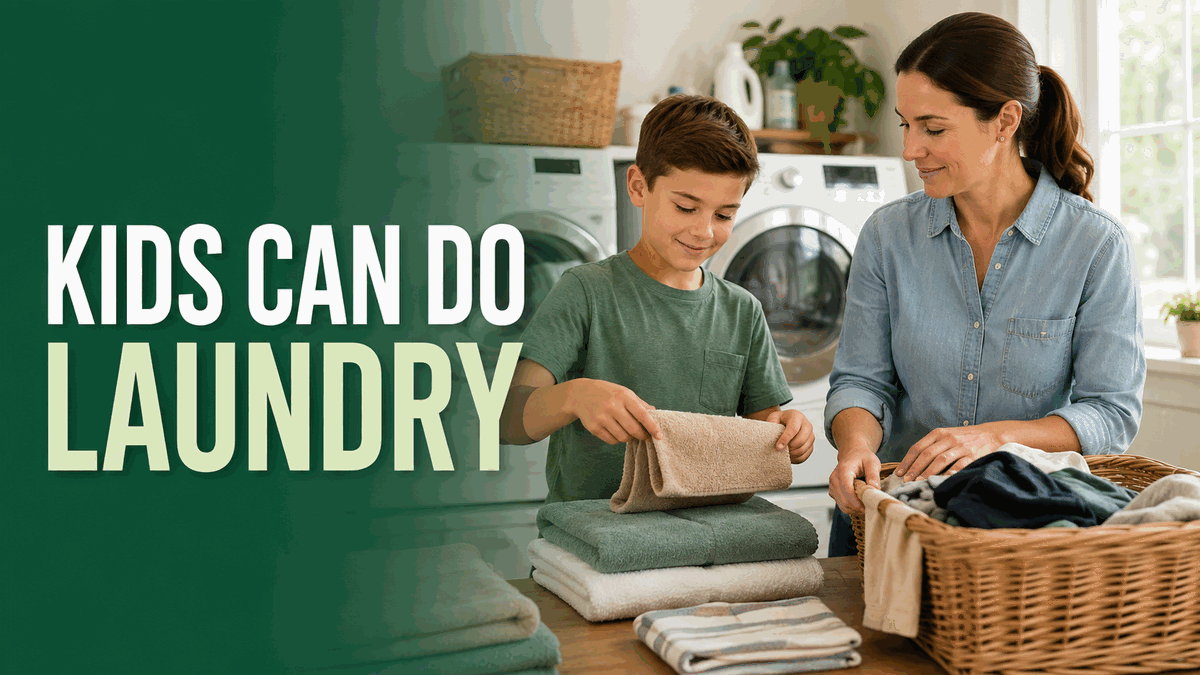
Laundry is the chore that turns a reasonable Sunday into a resentful one. Not because the machine is hard — you press a button — but because “doing laundry” is really eight small chores stacked on top of each other, and if any one of them stalls, the whole pile lives on the guest bed for four days. Teaching kids to do laundry is not really about teaching kids to do laundry; it’s about breaking one giant invisible chore into small pieces a small person can actually finish alone.
The good news is that most of those pieces are age-appropriate a lot earlier than parents think. A four-year-old can genuinely own a step. An eight-year-old can run a whole load with a checklist. A twelve-year-old can be responsible for their own wardrobe from dirty basket to hung-up jeans. The trick is knowing which step to hand over next, and setting the house up so the handoff actually sticks instead of quietly rolling back to you three weeks later.
Why laundry is different from every other kids’ chore
Most kids’ chores are self-contained. Setting the table has a start and an end. Feeding the dog has a start and an end. Laundry has neither. It arrives whenever someone changes clothes, moves through five separate locations (bedroom floor, hamper, washer, dryer, drawer), and the finish line keeps moving because someone is always wearing something that will be dirty by dinner. That’s why kids — and adults — struggle with it: the brain can’t see the shape of the job.
The single most useful mental shift for teaching kids to do laundry is to stop calling it “laundry” and start naming the six real chores hiding inside it: sort, wash, dry, fold, put away, and empty the hamper again. When you hand a kid one of those six as their job, the goalposts stop moving. When you hand a kid “the laundry,” you’ve handed them fog.
Sorting is the step kids can own first
If you only ever teach a kid one part of the laundry routine, make it sorting. It’s the step that turns an abstract chore into a concrete task, it needs almost no supervision after the first week, and it’s the single point in the process where a small person’s help genuinely saves the parent time. A five-year-old can do it. A three-year-old with help can start to do it. And the second sorting stops being your job, the whole pipeline moves faster because the washer never sits waiting for someone to figure out darks-versus-lights at 9pm.
The setup that makes this actually work at a small-kid’s scale is a labeled 3-bag sorter that lives in the laundry room or the hall closet — one bag for lights, one for darks, one for towels — on wheels so a child can push it to the washer when it’s full. The visual is doing the teaching: a kid looks at the shirt, looks at the three bags, and drops it in the matching one. No decision, no adult, no fog. We use the Seville Classics 3-bag sorter cart at our house and it’s the single piece of laundry-room hardware that changed the routine from “Mom, where does this go?” into a kid quietly doing it themselves after their bath.
Three labeled bags on wheels turn “sorting” into a task a 5-year-old can actually own — look at the shirt, drop it in the matching bag, push the cart to the washer when full. Removes the decision that used to require you.
Check price on Amazon →Whatever sorter you use, the rule is the same: the hamper in the bedroom is a one-bag hamper. The sort happens in the laundry area, not upstairs. Kids can carry a full one-bag hamper down the hall and dump it into the sorter cart. Asking a six-year-old to pre-sort in their bedroom is asking them to make three decisions instead of zero, and it will not survive the second week.
Laundry chores by age — what to hand over, and when
These are ages where a typical kid can genuinely own the step alone after about a week of coaching. Every kid is different; some are ready earlier and some later. The point is the order, not the birthdays.
| Age | Can own alone | Can do with help |
|---|---|---|
| 3–4 | Put dirty clothes in the bedroom hamper. Match socks from a pile. Move wet clothes from washer to dryer (with a step stool). | Sort lights/darks/towels into the labeled sorter. Push the “start” button on the washer. |
| 5–6 | Sort the whole basket into the 3-bag cart. Load the washer and press start. Empty the dryer into a basket. Put their own folded pyjamas in their drawer. | Fold t-shirts and washcloths. Hang small hangers with parent nearby. |
| 7–8 | Run a full load start to finish for their own clothes (sort, load, add detergent from a pre-portioned cup, start). Fold t-shirts, shorts, washcloths. Put all their own folded laundry away. | Hang up shirts and dresses. Read cycle labels. Deal with a stain by pre-treating. |
| 9–11 | Own an entire load of family laundry, not just their own. Choose the right cycle. Pre-treat visible stains. Fold and put away everyone’s socks and towels. | Handle a small delicates load. Deal with a shrunk sweater. Empty the lint filter. |
| 12+ | Their entire wardrobe end to end — hamper to hung-up jeans, on their own schedule, no reminders. Should know delicates, hot vs cold, and how to iron a school shirt. | Own the family towels or family sheets as a weekly chore. Handle a dry-cleaning drop-off. |
The reason the twelve-plus row matters: laundry is one of the last chores parents give up, and it’s often the one that follows a kid to college as an unsolved skill. A twelve-year-old who has been doing their own wash for a year is a seventeen-year-old who packs for a school trip without a panicked text from a dorm four years later. Chores for teens should include laundry not as punishment but as a life skill their future flatmate will be grateful for.
How to teach kids to do laundry — the actual coaching
Handing a kid a chore is not the same as teaching them to do it. Most laundry handoffs fail in week two because the coaching phase got skipped. This is the pattern that works.
Do it with them three times. Not once. Not four. Three. First time you narrate every step and they watch. Second time they do the step and you narrate. Third time they do it and you say nothing unless they ask. On the fourth load, they’re alone. Skip any of those three and the habit collapses.
Print a two-column checklist and tape it above the washer. Left column: wash steps. Right column: dry steps. Six or seven bullets each, big font, waterproof if you can. Kids — and adults — forget the order of a chore they only do once a week. A checklist on the wall means a nine-year-old can restart the load themselves after a day off school without anyone re-teaching them.
Pre-portion the detergent. A small kid should not be pouring liquid detergent from a heavy jug. A single-dose pod, or a pre-filled cup on top of the machine, removes the one dangerous step and the one place a kid will over-pour on their first solo load. Pods also remove the “how much?” decision, which is the second-most-common reason a kid gives up mid-load.
Let them ruin a shirt once, on purpose. The most memorable laundry lesson we ever taught was accidentally: a red sock in a load of whites turned every family t-shirt pink for six months. Nobody ever forgot to check for stray socks again. A shrunk sweater or a pink shirt is a $12 tuition fee for a lesson that will save your kid’s clothes for the next fifty years. Don’t stage it — just don’t rescue every mistake before it happens.
Fold together for the first month. Folding is the step most kids find genuinely boring, and it’s the step most likely to become the parent’s job by default. Turn it into shared time instead: a folding basket on the couch, one episode of something the kid picked, and everybody folds. Kids folding laundry alongside a parent will keep doing it; kids folding laundry alone in a bedroom will not. After a month of pairs-folding, most kids will happily fold their own pile solo, because the association is with warmth and TV, not with punishment.
A weekly laundry routine for families
A laundry routine for families works when it’s tied to something predictable, not to “when the basket is full.” “When the basket is full” is how you end up doing five loads on a Sunday afternoon while the kids are on screens. A weekly rhythm looks like this:
Monday and Thursday — wash days. Two loads per adult, one per kid, spread across the week. Two days is enough to keep the pile from ever becoming a mountain, and it means no single day is eaten by laundry.
Kids sort on Sunday evening. Bedroom hamper into the sorter cart, small chore, five minutes each. That means Monday morning the first load can go in before the school bus.
Fold-and-fold night on Wednesday. A single dedicated 25-minute block where the family folds together in front of a show. This is the piece that keeps folding from becoming a pile on the guest bed.
Every kid puts their own away, always. No matter who folded. This is the rule that keeps the chore from silently defaulting back to a parent. A basket outside their bedroom door with their name on it is enough of a system.
If you’re building a wider stack of low-lift kid chores, our age-appropriate chores for kids guide has the same age-by-age approach applied to the rest of the house, and the chore chart for kids that works post is the one to read if you’re about to make yet another Sunday chart that dies by Tuesday.
Why laundry is worth tracking as a habit, not a task
Kids laundry chores are the classic example of a chore that fails as a to-do item and works as a habit. A one-off task (“fold the basket”) needs a nag. A weekly rhythm (“Wednesday is fold night”) runs itself after about six weeks. What separates the families whose kids actually do laundry from the ones where the pile lives on the guest bed forever is not effort — it’s the difference between chasing tasks and building a rhythm.
That’s the piece we designed Famello for. It’s the ad-free family app we built so the small weekly rhythms — fold night, Sunday sort, the kid’s own-laundry streak — live in one shared calm place instead of on a whiteboard nobody looks at. A habit called “my own laundry” that a nine-year-old checks off on Sundays turns into a real streak by Christmas, and a streak is what a kid will keep going when a chore chart wouldn’t. It’s private, shared only with your family, and there’s nothing sold on. Same logic sits behind our family habit tracker streaks post if you want the full argument for rhythms over reminders.
Teaching kids to do laundry — the short version
Stop treating laundry as one chore. It’s six: sort, wash, dry, fold, put away, empty the hamper again. Hand a small kid one piece at a time and the whole thing becomes learnable. Start with sorting at four or five — a labeled 3-bag cart in the laundry room does the teaching for you. By seven or eight, most kids can run a full load of their own clothes end to end if the detergent is pre-portioned and there’s a checklist above the washer. By twelve, a kid should own their entire wardrobe from hamper to hung-up jeans, no reminders, on their own weekly rhythm. Coach in threes — do it with them three times, then step back — and fold together for the first month so the habit gets built with company, not in isolation. Tie the routine to fixed days (wash Monday and Thursday, sort Sunday, fold Wednesday) instead of “when the pile is big,” and every kid puts their own away no matter who folded it. A kid who learned laundry as a rhythm at eight is a teenager who packs for camp without a text home, and a young adult whose flatmates are quietly grateful. That’s the real reason chores for teens should include laundry — not to lighten your Sunday, but because it’s the life skill most likely to follow them out the door.
Turn “fold night” into a streak, not a nag.
Famello is a private family journal, habit tracker, and shared calendar in one calm space — so the weekly rhythms worth keeping (sort day, fold night, your kid’s own-laundry streak) stop being “we meant to” and start running themselves. Ad-free, nothing sold on.
Related reading: Age-appropriate chores for kids — what a 4-year-old can actually own · Chore chart for kids that actually works past week two · Family habit tracker streaks — why they beat charts · How to teach kids to be organized