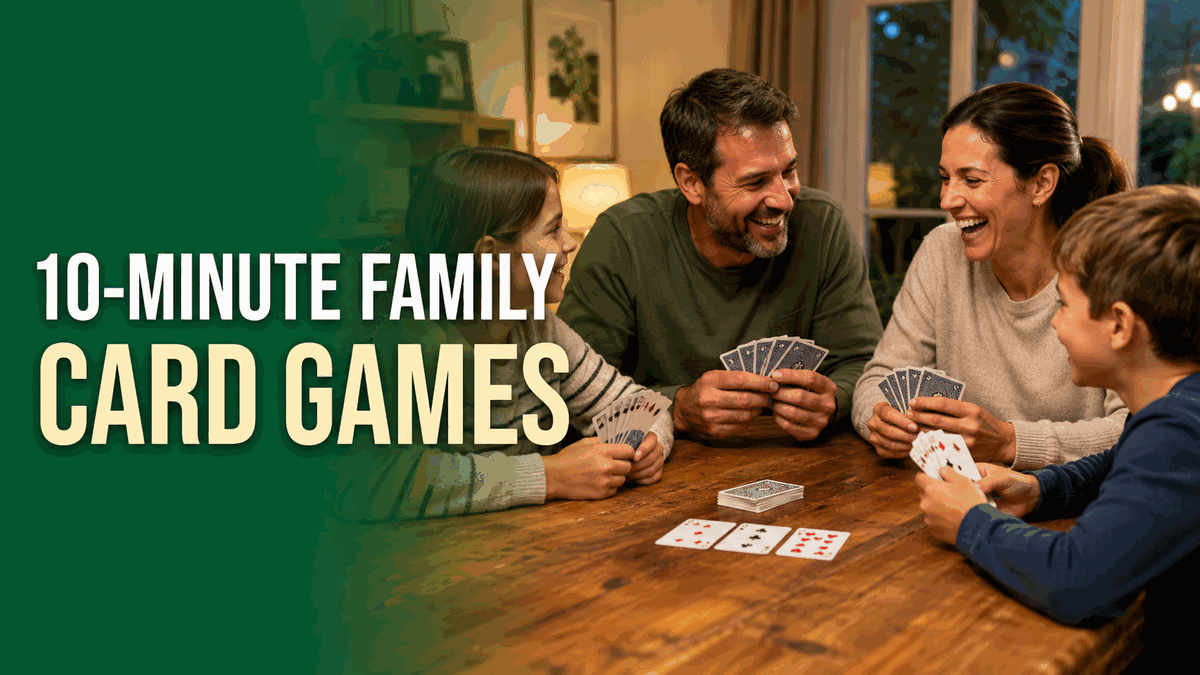
Board games are lovely and they mostly sit in a closet. A big box takes twenty minutes to set up, thirty to explain, an hour to play, and if a small person melts down at minute forty-five you’ve just watched an evening evaporate. Card games are the opposite. A deck fits in a pocket, the rules are learned in a round, a game ends in ten minutes, and if the four-year-old bails you shuffle up and keep going. That is why, on the average Tuesday, the best family card games do more heavy lifting for family time than any $60 box.
This is the short, honest list. Every game below has actually survived our house with a mixed-age table — the six-year-old who still needs help fanning a hand, the ten-year-old who wants to win, and the teenager who’d rather be on a phone but will play if it’s ten minutes. They pack into a suitcase, work at a campsite, and cost less than takeout.
Why 10-minute card games win the weekday
The reason card games beat board games on a weeknight isn’t the games — it’s the threshold. A kid will sit down for “one round of Uno” who will not sit down for “let’s play Ticket to Ride.” A parent who’s just done bathtime has ten minutes of good attention left, not sixty. If the game ends before either person’s battery dies, everybody leaves the table wanting to play again tomorrow. That is the whole magic. Short games get played; long games get talked about.
Ten minutes also solves the sibling-age problem. A four-year-old can lose gracefully in ten minutes. She cannot lose gracefully in an hour. A teenager will humor a card game for one quick round — and often gets sucked into a second and a third. The single most reliable predictor of a family that plays games together is that the games they own are short.
What makes a great family card game
Before the list, the filters we used. The best card games for families all check most of these boxes:
- Rules explained in under two minutes. If it needs a manual, it dies on the shelf.
- A round takes 5–15 minutes. Long enough to feel like a real game, short enough to squeeze in before bed.
- Ages 6+ can actually compete. Not just “play along” — genuinely win.
- Luck matters, so kids beat parents fair-and-square regularly. Pure-skill games sour fast when you’re seven.
- Fits in a pocket or backpack. The best family card games double as travel card games.
- Costs under $20. Anything more and it lives in a special box, which means it stops getting played.
Almost every classic that holds up — Uno, Spot It, Sushi Go, Sleeping Queens — passes every one of these. The ones that don’t pass usually fail on the first: too many rules, and the game never leaves the shelf.
The best family card games, sorted by what they do best
Rather than a pointless ranking, here are the games grouped by the job they do. Almost every family we know that plays cards regularly owns three or four of these — not all ten.
The gateway game — Uno. Still the best introduction to family cards, and there is a reason it’s sold a hundred million decks. Ages 5 and up can play a real game, rules take ninety seconds, and a round runs 8–12 minutes. The one house rule worth adopting: whoever holds cards when someone wins tallies points, and you play to 200 across several rounds. It turns a single game into a mini-tournament and takes the sting out of losing one hand.
The one that works with mixed ages — Taco Cat Goat Cheese Pizza. This is the game we reach for first when the table has a first-grader and a middle-schooler at it. Everyone shouts one of five words in order (“taco, cat, goat, cheese, pizza”), slaps the pile when the card matches the word, and slaps first on the special cards (narwhal, groundhog, gorilla). It’s absurd, it’s fast, a round is five minutes, and a six-year-old can beat a fourteen-year-old on pure reflex. It travels perfectly — the deck is tiny — and it has resurrected more sulky evenings than we can count.
The standard answer for a table with a 6-year-old and a 14-year-old at it. Rules in ninety seconds, a round in five minutes, tiny deck that lives in a backpack — and reflex-based, so the youngest player wins as often as anyone else.
Check price on Amazon →The travel game — Spot It! A tiny tin that fits in a glovebox, and the only rule is “find the matching symbol between two cards.” A four-year-old can play a simplified version; a nine-year-old will consistently beat you. Perfect for a restaurant table, a plane tray, or the twenty minutes between activities at a campsite. Works with 2–8 players — scales up to a whole cousin table without breaking.
The lightly-thinky one — Sushi Go! Card-drafting sounds fancy, but the whole game is “pick a card, pass the hand, count sushi at the end.” Kids from about 7 can play the full game and win. Rounds take 12–15 minutes, the art is adorable, and there’s just enough strategy that adults don’t glaze over. The tin also survives a decade of backpack abuse.
The one your teenager will actually play — Exploding Kittens. Cheeky, quick, and the game a bored fourteen-year-old will sit down for because the box is funny. Ages 7+ officially, though we’d say 8+ for the reading. Ten minutes a round, and it turns into a lot of shouting when someone plays a defuse card in the last second, which is exactly what you want.
The bring-Grandma-in classic — Skip-Bo. The best card game for a table that includes a grandparent who doesn’t want to learn something new. Simple sequencing, no reading required, and a round lasts 15–20 minutes at a friendly pace. Skip-Bo is the game we play at family gatherings when three generations are at the table and someone is on their second cup of tea.
The one for the counting-and-planning kid — Phase 10. Similar family to Uno but with a longer arc — you work through ten “phases” over the course of a play session. Best for ages 8+ because you have to track objectives. Great weekend game rather than weeknight; a full game runs 45–60 minutes, but a single phase is a proper ten-minute round if you just want a taste.
The memory game that’s actually fun — Rat-a-Tat Cat. A little-known gem that plays as low-stakes memory game with sneaky “peek” and “swap” cards. Ages 6+, rounds under ten minutes, and it’s one of the few “kids’ games” adults enjoy on their own merits. Sleeps in the same drawer as Sushi Go for us.
The princess-with-teeth — Sleeping Queens. Written by a six-year-old, which is why it works so well for kids that age. Wake queens, defend from kings, use math cards (2+3=5) to draw more cards. Kids 5–10 love it; teenagers roll their eyes but play. Twelve-minute rounds, and the youngest player really can beat the whole table.
The one that changes every round — Fluxx. The rules change every card. Best for ages 8+ because you need to read, and best for families whose kids like a bit of chaos. Rounds are unpredictable (5–20 minutes) which is either a feature or a bug depending on your patience — but no two games are the same, so it doesn’t get old.
Family card games at a glance — ages, players, playtime
If you’re trying to pick two or three to start with, use this. The best card games for kids in a mixed family are typically the top four here.
| Game | Ages | Players | Playtime | Best for |
|---|---|---|---|---|
| Uno | 5+ | 2–10 | 8–12 min | The gateway; the one everybody knows |
| Taco Cat Goat Cheese Pizza | 6+ | 2–8 | 5 min | Mixed ages at the same table |
| Spot It! | 4+ | 2–8 | 5–10 min | Travel; the glovebox game |
| Sushi Go! | 7+ | 2–5 | 12–15 min | A tiny bit of strategy without the fatigue |
| Exploding Kittens | 7+ | 2–5 | 10 min | The teenager will actually play this |
| Skip-Bo | 7+ | 2–6 | 15–20 min | Three-generation tables; family gatherings |
| Sleeping Queens | 5–10 | 2–5 | 10–12 min | Kids under 10 who want to win on their own |
| Fluxx | 8+ | 2–6 | 5–20 min | Families that like a bit of chaos |
If you own three of these — one gateway, one mixed-ages, one for the drawer of the car — you have enough. You don’t need a shelf full. The best family card games get better with repetition, not with variety.
How to turn card games into a weekly habit
Owning the games is the easy part. Reaching for them on a Tuesday when the kids are wired and you’re out of dinner ideas is the hard part. Three things move card games from “we should play more” into an actual weekly thing:
Keep one deck on the dinner table. Not in a cupboard. On the table, in a small basket, alongside the salt. The friction between “we should play a game” and “we’re playing a game” is the twelve seconds it takes to walk to the cupboard, and most nights those twelve seconds are the whole difference. A deck already at the table gets picked up while the last person is finishing dessert. A deck in a cupboard does not.
Play the ten-minute rule. When homework’s done or the plates are cleared, one card game before screens. Not “maybe a game later” — one game, right now, ten minutes. The framing matters. A ten-minute commitment is easy to say yes to; a “family game night” is a whole event you have to schedule.
Track the streak like any other habit. This is the piece most families miss. Card games are exactly the kind of small, low-cost family ritual that sticks when it’s counted and quietly fades when it isn’t. A visible tally — a sticker on the fridge, a shared family app, a mark on a whiteboard — turns “we play sometimes” into “we’ve played eighteen weeks in a row.” That count is what your kids will remember at twenty. Famello is the ad-free family app we built for exactly this: a shared timeline for the small family things you want to keep doing, a habit called “cards after dinner” that tracks the streak, and a journal a kid can drop a one-line entry into (“beat Dad at Taco Cat three times in a row”) that’ll be worth reading in ten years. Same logic sits behind our family movie night ideas and the best family board games guide if you’re building a wider stack of low-lift family rituals.
Card games for travel, campsites, and restaurants
If you’re packing for a trip, the best travel card games are the tiny-tin ones: Spot It, Taco Cat Goat Cheese Pizza, Sushi Go, Exploding Kittens. All four fit in a jacket pocket, all four survive a picnic table with a spilled juice box, and all four run in under 15 minutes so a restaurant appetizer wait becomes a mini game night instead of four kids on four phones. A restaurant that lets you play a card game between courses is a restaurant your kids will actually want to eat at.
For a campsite, a headlamp and a deck of Uno at 8:30pm is a memory that beats almost anything a screen produces. If you’re taking a plane, Spot It on the tray table is the single most effective “kill an hour” item in a carry-on, at a fraction of the space of a coloring book.
Best family card games — the short version
Card games do more for family time on a random weeknight than the biggest game in your closet, because the box is small, the rules are quick, and a round ends before anyone’s battery dies. Start with three: Uno as the gateway everyone already knows, Taco Cat Goat Cheese Pizza for the mixed-age table where a six-year-old and a teenager can both actually win, and Spot It! as the travel tin that lives in the glovebox for restaurants, planes, and camping. Add Sushi Go! once the kids are seven-ish for a taste of light strategy, and Skip-Bo for three-generation gatherings when grandparents are at the table. Keep one deck on the dinner table, not in a cupboard — the twelve seconds of friction is the whole difference between “we should play more” and actually playing. Use the ten-minute rule (one round after dinner, before screens) and track the streak somewhere visible; card games are the kind of small ritual that quietly becomes a childhood memory when someone bothers to count it. Twenty years from now your kids won’t remember most of what you watched or bought them — they’ll remember the deck on the kitchen table and the round of Uno you played on a Tuesday.
Turn “cards after dinner” into a streak.
Famello is a private family journal, habit tracker, and shared calendar in one calm space — so the small family rituals worth keeping stop being “we meant to” and start being a streak your kids are proud of. Ad-free, nothing sold on.
Related reading: Best family board games that actually get played · Family movie night ideas that make it a real tradition · Screen-free activities for kids that don’t feel like homework · Outdoor activities for kids beyond the same park