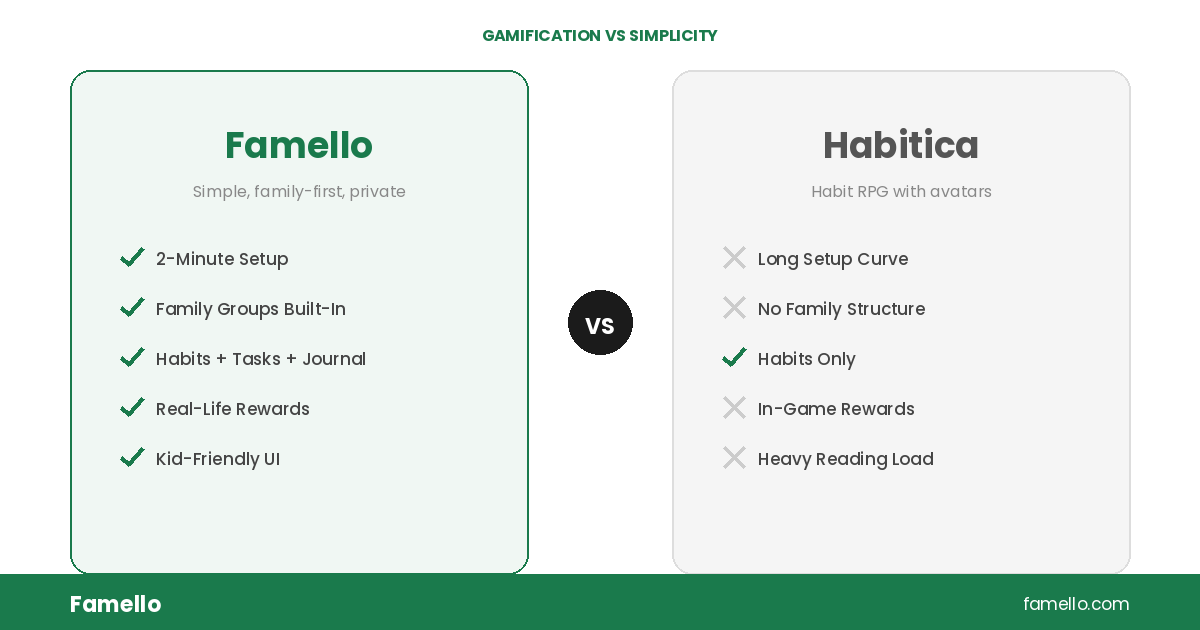
If you've spent more than ten minutes researching habit trackers, you've run into Habitica. The pixel-art avatars, the experience points, the guilds, the daily quests — it's the most gamified habit app on the market, and that's part of why it's developed such a devoted following. But it's also why so many parents type "habitica alternative" into Google after a few weeks of trying to use it with their family.
Habitica and Famello are both habit trackers in the loosest sense. In practice, they're built for different people, with different priorities, and they feel completely different to use. This post lays out where each one is strong, where each one falls short, and which kind of family will actually stick with which app.
Short version: if your family loves video games and wants their habit tracker to feel like one, Habitica is hard to beat. If you want something that takes two minutes to set up and works for kids, parents, and grandparents alike, Famello is probably the better fit.
Habitica vs Famello: Quick comparison
Here's the side-by-side before we go deeper:
| Feature Habitica Famello | ||
| Core approach | RPG with avatars, levels, quests | Clean dashboard, streaks, no game layer |
| Setup time | 15-30 min (character creation, party setup) | Under 2 minutes |
| Habit tracking | ✅ Yes (Habits, Dailies, To-Dos) | ✅ Yes (daily, weekly, custom schedules) |
| Streak tracking | ✅ Yes (in Dailies) | ✅ Yes (with milestone bonuses at 7 and 30 days) |
| Family/group features | Parties and Guilds (not family-native) | Family Groups with invite codes |
| Journaling | ❌ No | ✅ Yes (rich text, mood, photos, tags) |
| Mood tracking | ❌ No | ✅ Yes (5-level with emojis) |
| Tasks / chore assignment | To-Dos exist; not designed for assignment | ✅ Yes (assign to family, priorities, subtasks) |
| Reward system | In-game rewards (gear, pets, mounts) | Custom real-life rewards (Premium) |
| Kid-friendly | Reading-heavy, complex UI | Designed for ages 6+ |
| Ads | ❌ No ads | ❌ No ads, ever |
| Pricing | Free / $5/mo subscriber perks | Free / $4/mo Premium |
What Habitica actually is
Habitica turns your real-life to-do list into a role-playing game. You create a character, pick a class (Warrior, Mage, Healer, Rogue), and earn experience and gold for completing Habits, Dailies, and To-Dos. Skip a Daily and your character takes damage. Complete enough tasks and you level up, unlock gear, hatch pet eggs, and ride mounts.
The social layer is built around Parties (small groups that fight bosses together) and Guilds (larger interest-based groups). If your party member misses their habits, the boss damages everyone — which creates real accountability if your party takes the game seriously.
For a certain kind of person, this works beautifully. People who already play RPGs find the metaphor instantly familiar. Adults who feel like productivity apps are too dry get a hit of dopamine every time their wizard levels up. There's a reason Habitica has a community of hundreds of thousands of users who've stuck with it for years.
Where Habitica really shines
Three things Habitica does better than almost anyone else:
Intrinsic motivation through play. If you're someone who needs the next dopamine hit to actually start a task, the RPG framing genuinely helps. Levelling up your character makes flossing feel like progress in a way most apps don't manage.
The accountability mechanic. The Party feature, where your character takes damage if you skip a Daily, creates social pressure that's hard to replicate. People in active parties report dramatic improvements in consistency.
Community and content. Habitica has been around since 2013 and has a deep library of guilds, challenges, and shared content. If you want to join a "writers daily streak" guild or a "no soda for 30 days" challenge, there's probably already one running.
It's also worth saying: Habitica has no ads. The free tier is genuinely usable, and the optional $5/month subscription is for cosmetic perks and supporting development, not for unlocking core features.
Where Habitica falls short for families
Habitica was built for individuals, not families — and you feel that the moment you try to set it up for your household.
The first wall is complexity. There's a meaningful learning curve: Habits vs Dailies vs To-Dos, positive vs negative habit reinforcement, character classes, party mechanics, the difference between gold and gems, the marketplace, the tavern, sleep mode for vacations. By the time you've figured it all out, the seven-year-old you wanted to onboard has wandered off.
The second wall is reading load. Habitica's UI is dense with text and game terminology. Younger kids — exactly the age group where building habits matters most — struggle to navigate it without a parent driving. That defeats the purpose of a family habit tracker, which only works if everyone uses it independently.
The third wall is the lack of family structure. There's no "family group" concept in Habitica. You can put your family in a Party, but parties are designed for friends fighting bosses together, not for a parent assigning chores to a teen. There's no way to assign a task to a specific person, no priority system, and no easy way for parents to set up a kid's habits and review their progress.
Finally, there's no journal, no mood tracking, no real reward system tied to real-world outcomes. The rewards in Habitica are pixel-art swords and pet eggs. If you want your kid to earn an extra hour of screen time on Friday for completing their habits all week, you'll need a separate app or a paper chart. For families looking for a more complete family habit tracker, that gap matters.
What Famello is
Famello is built for families first, individuals second. The whole product is organized around a Family Group: you create one, invite members with a code, and now everyone's habits, tasks, and journals live in one private space.
There's no avatar. There's no XP. There's no boss fight. Habits have streaks, tasks earn points, and points can convert into custom rewards parents create — but none of it is wrapped in a game metaphor. The interface is a clean dashboard. A six-year-old can navigate it. So can a grandparent.
If Habitica's pitch is "make habits fun by turning them into a game," Famello's pitch is closer to "make habits stick by making the app effortless to actually use." Different philosophy, different audience.
Where Famello shines for families
Famello's habit tracker has the parts that matter and skips the parts that don't. You can set daily, weekly, or custom schedules. Streaks are tracked automatically with bonus points at 7-day and 30-day milestones. A calendar heatmap shows everyone's consistency at a glance. Habits can track yes/no completion or quantities (like "drink 8 glasses of water" or "read 20 pages").
The family piece is where it really separates from Habitica. Family Groups let parents see what each kid is working on, assign chores with due dates and priority levels, create recurring tasks, and award points for completed work. Tasks aren't just to-dos — they're a real assignment system that fits how families actually divide labor.
The journal feature has no real equivalent in Habitica. Each family member gets a rich-text journal with 5-level mood tracking, up to 5 photos per entry, tags, and a calendar view. Parents can keep their entries private, kids can keep theirs private, and shared entries (like a family trip recap) can go on the family timeline. It's the kind of thing that makes the app useful for the emotional side of family life, not just the logistical side. We dig into prompts and patterns in our family journaling guide.
And the rewards system is grounded in real life. Parents create custom rewards — extra screen time, choosing dinner Friday, a trip to the bookstore — and kids redeem points they've earned through habits and tasks. It scratches the same psychological itch as Habitica's gear drops, but with rewards that actually matter to a kid's week. We break down how to design these well in our family reward system guide.
Where Famello falls short
Honest moment: if you specifically love the RPG metaphor, Famello is going to feel flat compared to Habitica. There's no character to level up, no boss fights, no pet eggs to hatch. For users who get most of their motivation from the game layer, Habitica is irreplaceable.
Famello also doesn't have Habitica's depth of community challenges. There are no public guilds you can join, no global "writers' streak" group. Famello is designed to be private to your family, which is a feature for most families but a downside if you specifically want shared accountability with strangers on the internet.
Finally, Famello is a newer product. Habitica has been iterated on for over a decade. Famello is improving quickly, but it doesn't have the same library of edge-case features (custom rewards marketplaces, intricate party mechanics, etc.). If those things matter to you, that's a real difference.
Family setup: side by side
Imagine two parents trying to get their three kids — ages 7, 10, and 14 — onto a habit tracker.
In Habitica, each kid creates their own account and avatar. The 7-year-old needs a parent walking them through character creation, the marketplace, and the difference between Habits, Dailies, and To-Dos. To track everyone in one place, the family forms a Party. The parents can see each kid's character but can't directly assign chores; the kids have to add their own Dailies. After about a week, the 7-year-old has stopped logging in because the interface is too dense, the 14-year-old finds the pixel art "cringe," and only the 10-year-old (the family video game enthusiast) is still engaged.
In Famello, a parent creates the family, invites everyone with a code, and sets up each kid's habits in about ten minutes total. Each kid sees a simple list of what they need to do today, with checkboxes. Completed habits add to a streak. Tasks the parents assign show up in a clear, prioritized list. There's no learning curve because there's almost nothing to learn. After a week, all three kids are still using it because there was nothing to drop off from.
Both flows have value. Which one fits your family depends on the kids you have.
Pricing: Habitica vs Famello
Both apps are reasonable on price.
Habitica's free tier is genuinely usable — the entire core game is free. The $5/month subscription (or $30/year) adds cosmetic perks: extra avatar slots, exclusive gear, gem discounts, and a bonus pet/mount each month. It's pure support-the-developers / dress-up-your-character money.
Famello's free tier covers unlimited journals, 2 months of habit history, and a single family group with up to 4 members. Famello Premium at $4/month removes the limits — unlimited habit history, unlimited family members, and the full custom rewards system.
If you'd actually pay either one, Famello Premium is a dollar a month cheaper. But really, if you're a happy Habitica user, the $5 subscription is for fun, not necessity. The two apps aren't competing on price.
Privacy and the no-ads question
This is one place Habitica and Famello agree: neither shows ads. Both apps fund themselves through subscriptions rather than advertising. That's worth noting because most "free" family apps — Cozi being the obvious example — are ad-supported in the free tier. If you've been comparing apps and ads are a dealbreaker, both Habitica and Famello clear that bar.
The privacy difference is more about scope. Habitica has social features built in: party chat, guild discussions, public profiles. Even with privacy settings, your habit data is part of a social ecosystem. Famello is private to your family by default. There's no public profile, no guilds to join, no chat with strangers. For families with younger kids, that's often the safer default. We've written more on why that matters in our private family app post.
Who should pick Habitica
Pick Habitica if you (or the people in your household) genuinely love RPGs. If your kids are old enough to follow the game mechanics — generally 12 and up — and they're already gamers, the gamification can be a real motivator that other apps don't match.
Pick Habitica if you want a public community of strangers holding you accountable. The challenges and guilds are unique, and the energy of a writing streak guild or a fitness party isn't easily replicated elsewhere.
Pick Habitica if you're a solo adult and you'd describe yourself as someone who responds well to game design. Habitica is fundamentally an individual productivity RPG that happens to have group features. As a single-player tool with optional social features, it's excellent.
Who should pick Famello
Pick Famello if you have kids under 12 and you want everyone in the family using the same app. Famello's UI was designed with that range in mind — readable, visual, no jargon, no game mechanics to teach.
Pick Famello if you want more than habits. The journal, mood tracking, task assignment, and reward system are all native — not features bolted onto a habit tracker. If you've been juggling four apps (one for habits, one for chores, one for journaling, one for kids' rewards), this is the consolidation play.
Pick Famello if "private to my family" matters to you. If you don't want your kids' habit data sitting alongside public guild chats, the closed-by-default model is more comfortable.
And pick Famello if you want simplicity. Some users specifically don't want gamification — they want a checkbox, a streak, and to move on with their day. For those users, the lack of an avatar isn't a missing feature, it's the point.
The bottom line
Habitica and Famello aren't really fighting for the same person. Habitica is the best pure habit-RPG on the market and probably will be for years. Famello is the simpler, family-first habit tracker that also handles tasks, journaling, and rewards in one place.
If you've tried Habitica and bounced off because of the complexity, or because your kids couldn't get into it, Famello is the obvious habitica alternative to try next. If you love Habitica's RPG layer and just wish it had better family features, the honest answer is: Habitica is unlikely to add native family features, and Famello isn't trying to replace the RPG. Pick the philosophy that fits how your family actually works.
Either way, the best habit tracker is the one your family will actually open tomorrow morning